The three roles it takes to build a marketing agent
Scott Zakrajsek, 11 min read.
- published
- last verified
- category
- Team and Operating Model
- tags
- agent-skills, talent
- format
- Opinion, short
- built on by
- What Happens to the Agency Model When Agents Do the Production (planned)Growing Junior Talent When Agents Do the Junior Work (planned)
TLDR
- A marketing agent is only as good as the person who built it, so pick that person first.
- A marketing agent is AI software that carries out a marketing task in steps, following written instructions.
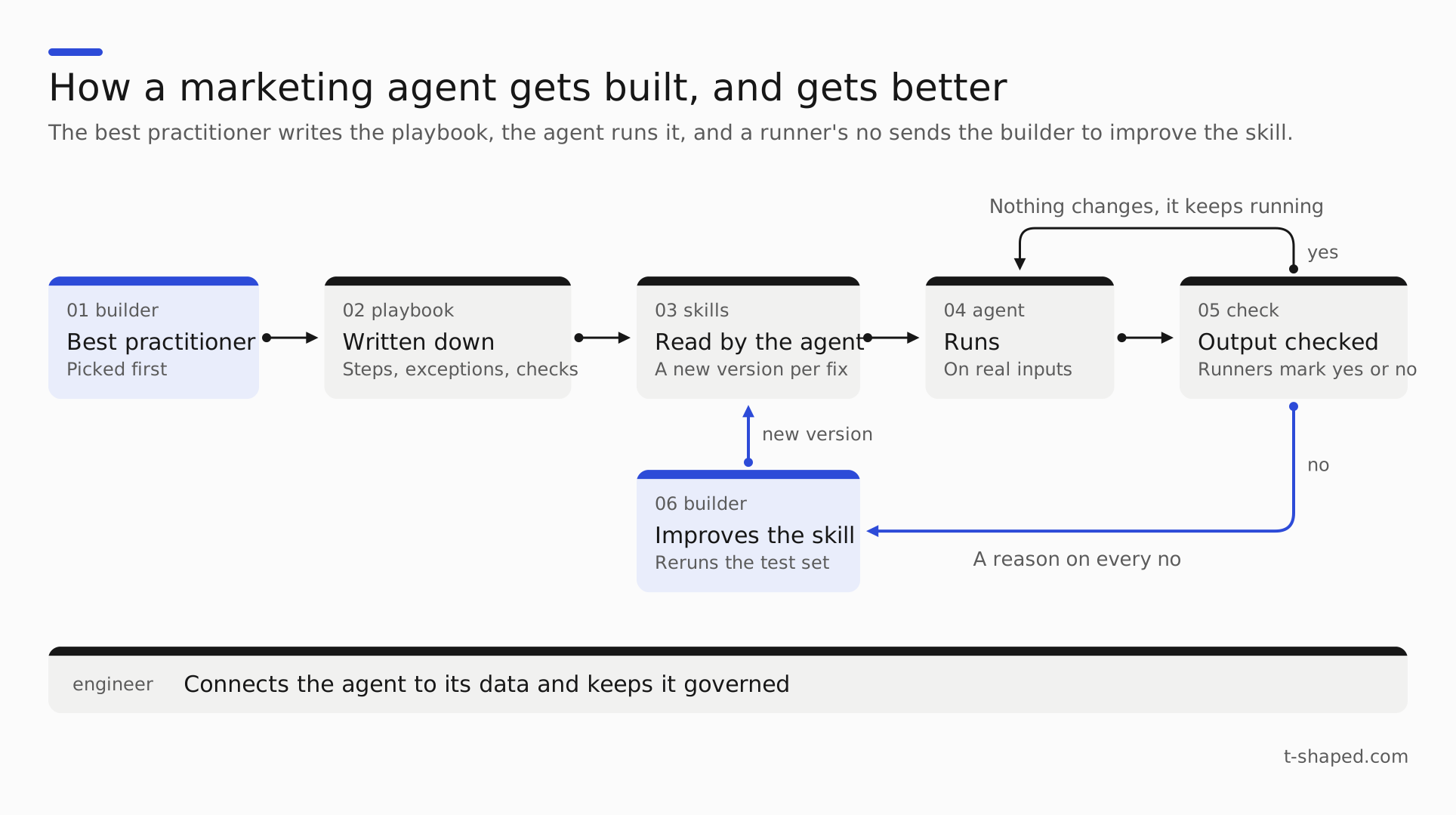
- Building one takes three roles, and the same person or team can be responsible for more than one: the builder, who writes the instructions; the runners, who use it and give feedback; the engineer or AI specialist, who connects, governs, and standardizes the agent.
- The agent builder should be your best person at the job, with protected time to document how they work.
- If you can, grow the engineer or AI specialist from your existing technical teams, for speed and cost. Hire one if nobody there can do it, or if large teams or an enterprise need specialized governance.
- Every agent needs one named owner and a set cadence to review, clean up, improve, and archive it, or it degrades until nobody uses it.
Key facts
- In a 2026 preprint (a study posted before peer review), over 99% of 238 agent skill files on a public skill-sharing marketplace broke at least one best practice for writing skills2.
- In a 2025 Gartner survey of martech leaders, half cited a shortage of technical talent4.
- As of July 2026, Nick Lafferty reports that at Samsara, marketing operations owns the shared setup for a marketing team of roughly 230 people with about 90 agents3.
Three roles build and maintain a marketing agent
A marketing agent needs three roles, and the same person or team can be responsible for more than one.
- The builder has done the job hundreds of times. They write down the playbook, test it, and groom it after launch, meaning they keep reviewing the output and refining the instructions.
- The runner is anyone who uses the agent day to day and gives the builder feedback. The builder is the first runner and the one who can tell a good output from a bad one.
- The engineer or AI specialist connects the agent to the company's data and systems and keeps it governed, meaning it follows the company's rules on data and access. Over the longer term, they also own optimization, monitoring, and cost efficiency, including token use (tokens are the units AI platforms bill by).
The playbook goes into an agent skill, a written procedure the agent loads when a task calls for it, with the steps, the exceptions, and the checks spelled out. The agent runs on an AI platform, a service built on large language models such as ChatGPT or Claude. Anthropic, the company that makes Claude, compares building a skill to "putting together an onboarding guide for a new hire"1.
A landing page agent shows what the builder knows
Take a landing page agent, for example. Its builder could be a senior conversion rate optimization expert, someone who has run hundreds of split tests, managed dozens of brand campaigns, and built hundreds or even thousands of landing pages. That person knows things no landing page template captures:
- The headline repeats the exact promise the visitor clicked on.
- The page asks for one thing, and every button leads to it.
- Proof sits where the visitor first starts to doubt.
- The likely objections get answered before the form.
- A shorter form/landing page brings more leads, and often weaker ones.
- A test runs to the sample size set before it started.
Landing pages come in many kinds, so the agent gets expanded over time for different brands and products.
It's OK if the playbook, and therefore the skill, doesn't cover every edge case at launch. The gaps get solved once people run the agent. Skills are not one-and-done: they keep improving through outputs, learning, and feedback loops.
Hiring one AI engineer or marketing engineer for all three roles is tempting, because your best practitioner stays on their day job. But a new hire learns your playbook second-hand and can't always tell when the agent is wrong, so they shouldn't be the builder.
Your best practitioner should be the agent builder
Pick the person who does the job best as the builder, find them through their managers, and protect their time in writing.
Handing the build to whoever has time has a real upside. An average agent still lifts every runner below average, and your best person stays on their work. Pick the best person anyway, because their time is spent once and the agent's quality repeats on every run.
Codify an average performer's ability into a skill and you get an average agent at scale.
Among your best people, the builder is usually the one who:
- explains the work as steps, including the exceptions
- cares where the numbers come from
- notices their own bad outputs and fixes them
- is the person colleagues already go to for help
- has already automated part of their own job without being asked
Ask the managers of the team that does the workflow who fits, and make the call yourself. Skip the open call for AI volunteers, because it selects for enthusiasm over skill. If nobody does the job well yet, there's no playbook to write down, so start the agent with another workflow. Solve that problem by hand, or bring in an outside expert such as a consultant or an agency.
Give the builder protected time in writing: time for the build, sized to how complex the agent is, and a smaller standing share after launch for grooming. Hand the work that time displaces to the rest of the team, and show that plan to the builder's manager before they object.
A junior team member is the wrong builder. A newer person has seen fewer cases, so the agent inherits the gaps, and asking ChatGPT or Claude to write the skill with no expert in the room has the same problem. Make newer people runners instead. They pick up new tools fast and try inputs the builder wouldn't think of.
The agent builder writes the skill, data rules, and test set
Before anyone else runs the agent, the builder writes three things:
- The skill, the playbook as written steps.
- The data rules, which say which numbers to trust.
- A test set of real past cases, the most important of the three.
A documenter interviews the builder out loud
Writing the skill is hard because experts often can't explain how they decide until someone asks the next question. Pair the builder with a documenter who asks those questions, such as a project manager or your engineer or AI specialist, and let the builder correct the draft.
Have the documenter interview the expert and record it. People give much richer detail on a process when they talk it through than when they write it down or someone takes notes.
Data rules tell the agent which number to trust
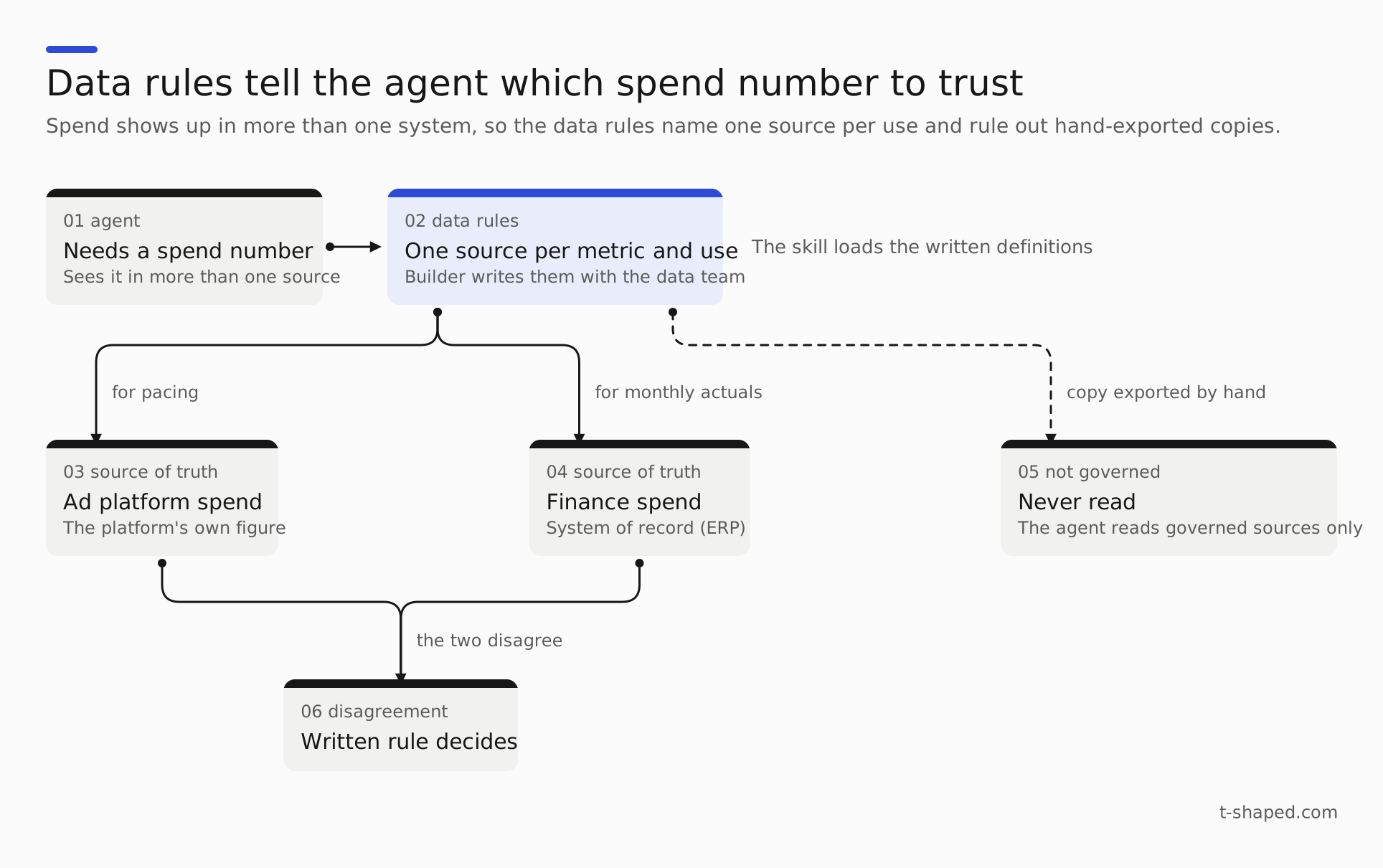
Most marketing agents will need to read numbers or query data. An agent that sees a spend figure from more than one source, for example the ad platform and the finance system of record (the ERP, or enterprise resource planning software), will confuse the source of truth unless it has a rule. The builder must write the data rules with whoever owns the metric definitions, usually the data team:
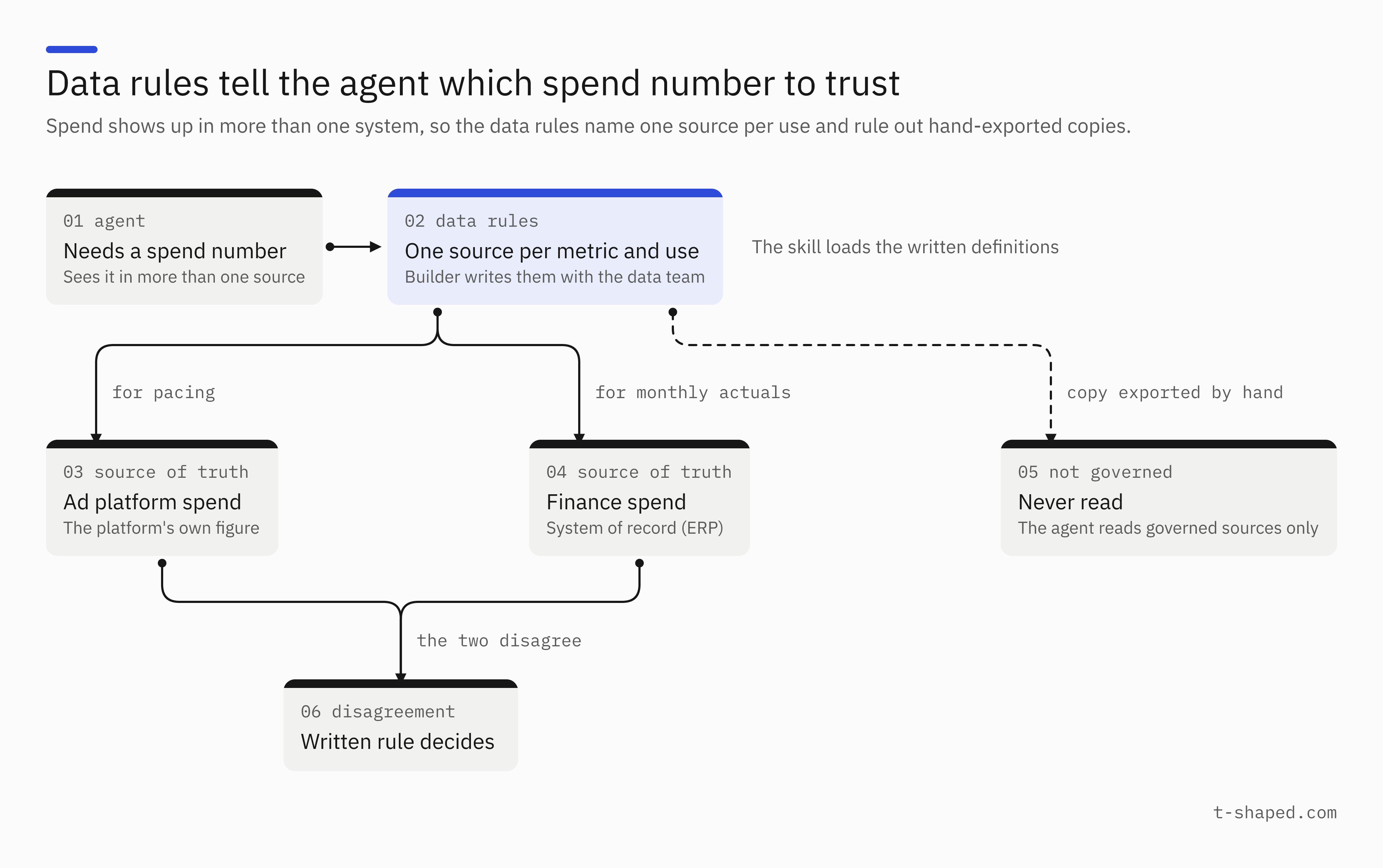
- A source of truth for each metric and each use, such as ad platform spend for pacing and finance spend for monthly actuals.
- Written definitions the skill can load.
- A rule for disagreements between two sources.
- Governed sources only, never a copy someone exported by hand.
Download: SVG, PNG. Wider than the screen: swipe sideways, or download the PNG.
Longer term, your organization should invest in maintaining a semantic layer and a data catalog to hold these rules. A semantic layer is one shared set of metric definitions that every tool reads, and a data catalog is a searchable record of what each data set holds and who owns it.
A test set of real past cases checks every change
Each case pairs a past input, awkward ones included, with the checks your expert uses to call an output good. Anthropic's guidance for skill authors says to "Start with evaluation" by running the agent on typical tasks to find where it struggles, then building the skill to close those gaps1. The builder reruns the test set after every change to the skill.
Feedback from runners keeps a marketing agent improving
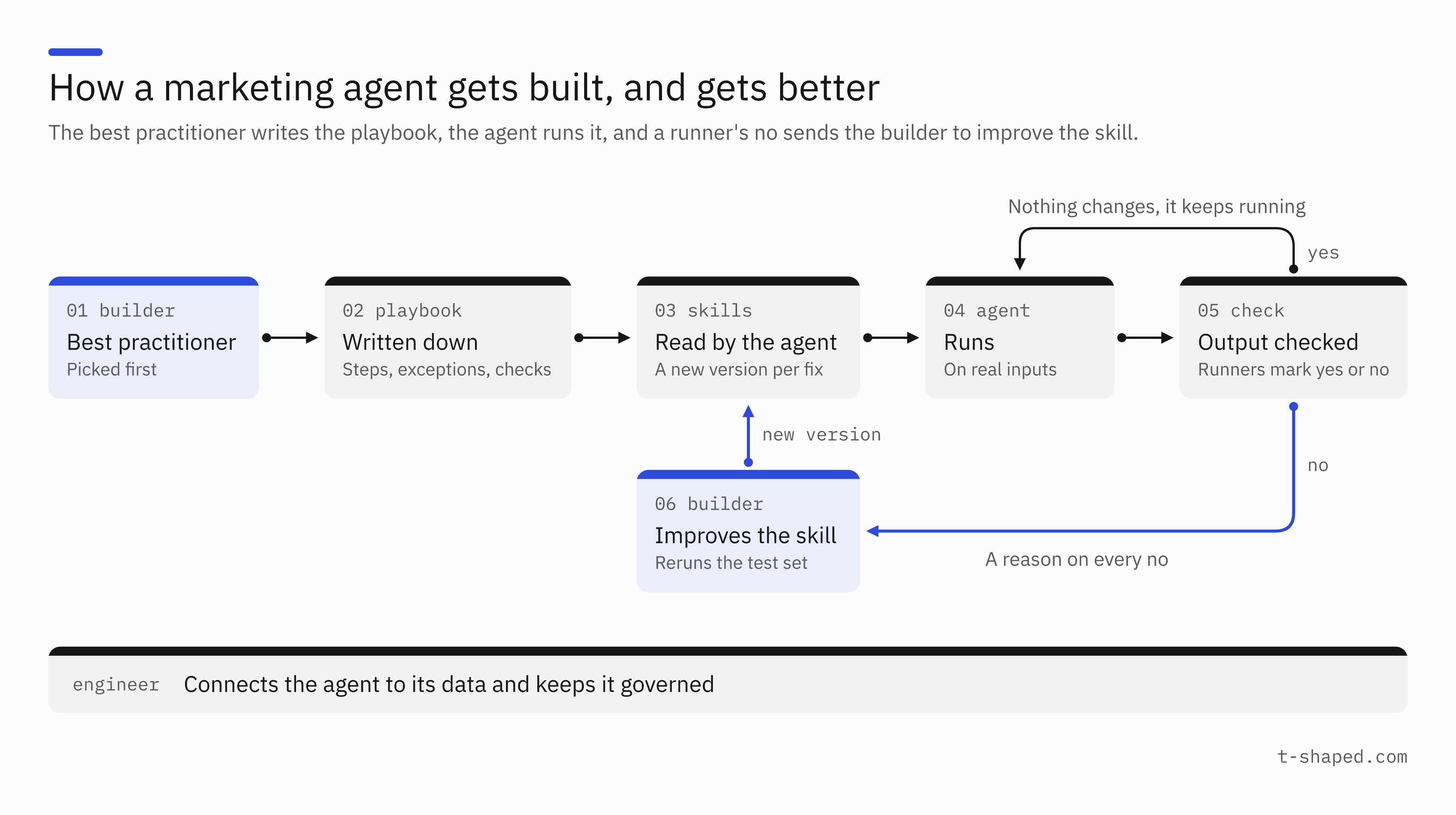
An agent gets better when runners mark its outputs yes or no, with a reason on every no, and the builder acts on each no by improving the agent and its skills. A yes changes nothing, and the agent keeps running. That's the feedback loop.
A runner can tell whether an output was usable for their job, and a bare no gives the builder nothing to check. The builder judges why each no fell short and widens the skill where real inputs hit cases the first version missed.
Marketing agents degrade quietly when nobody grooms them
Left alone or patched carelessly, an agent degrades for reasons nobody sees:
- Model updates change the output, and nobody checks how.
- The business moves, and new products and brand rules leave the skill out of date.
- Patches pile up one bad output at a time, and nobody rewrites the whole.
- Bloat makes the agent wordy and it starts skipping steps.
- Overfitting leaves it handling only the cases it was tuned on.
Over 99% of 238 agent skill files on a public skill-sharing marketplace broke at least one best practice for writing skills, a recent preprint (a study posted before peer review) found2.
The paper found that once a skill broke a best practice, the break rarely went away in later versions2. Revising a skill doesn't clear its flaws, so the builder rereads the whole skill against those best practices instead of only patching bad outputs.
Measure the agent's work against the old way
Logins and prompt counts show whether people still use the agent, not whether its work is good. Record the old way before launch and measure the agent's work against it:
- time per deliverable
- the share of outputs that pass the builder's spot check
- the error rate
The failure I see most often starts at launch. The agent is fast and saves time, so people assume its output is good and take it. Nobody stops to review what goes out or to send what they find back to the builder, and the result is silent adoption of an agent that is not good, or at least could get better. So before a larger group gets it, run a first check: the builder reviews its outputs on new, real inputs, ten for example.
Because every runner loads the same skill, a fix the builder makes reaches all of them at once. Make changes early and often, and rerun the test set before each one goes out. Over the last couple of years each model release has needed less direction from us to perform, so rerun the test set every time the model changes, and expect to remove direction from the procedure as well as add it.
Each agent gets one owner, and an AI specialist runs the workspace
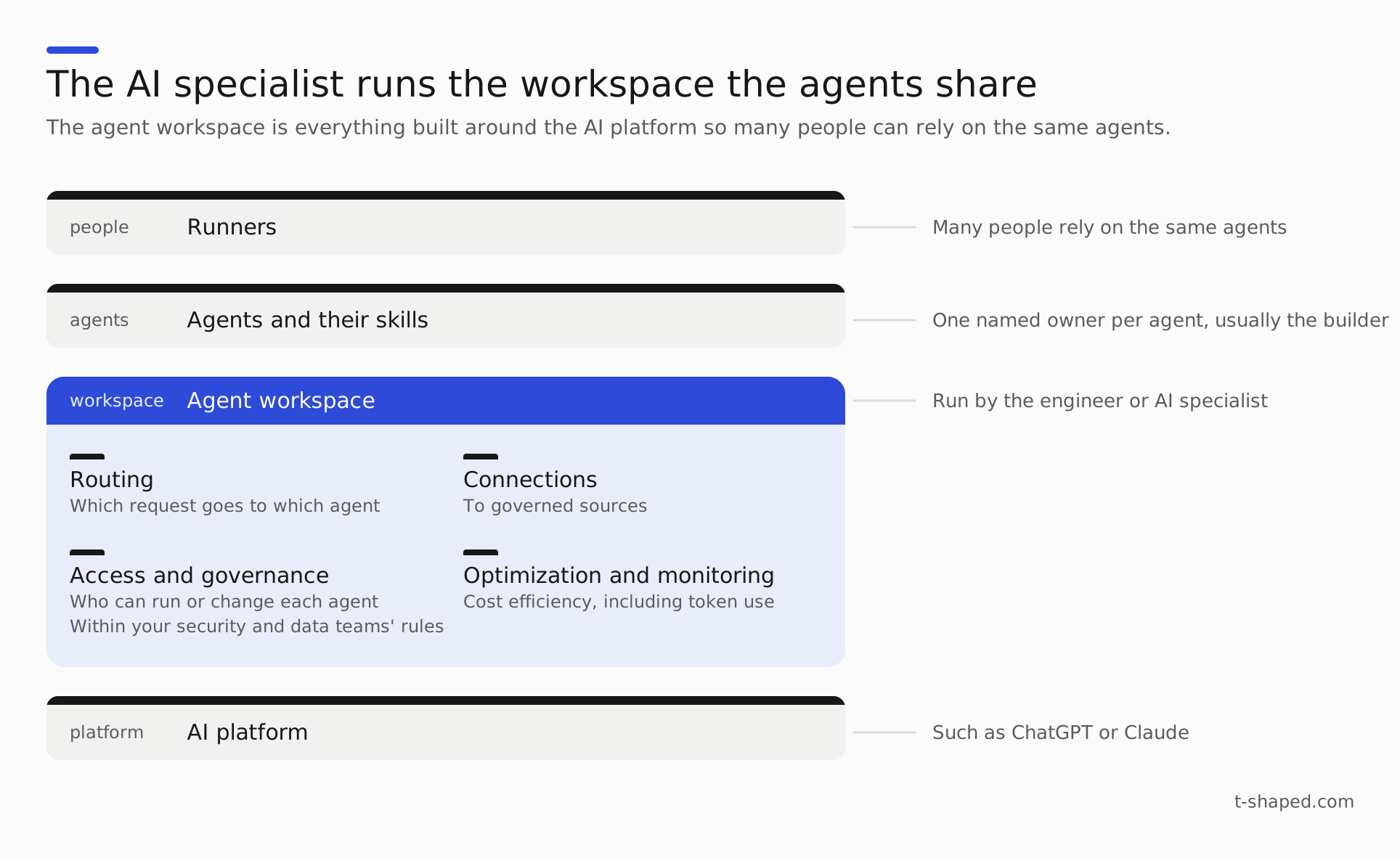
Every agent gets one named owner on a set review cadence, and the engineer or AI specialist runs the workspace the agents share.
One named owner reviews each agent on a set cadence
The owner is usually the builder. They answer for the agent and the skills it shares with the team. On a set cadence, they review it, clean it up, improve it, and archive it once nobody uses it.
With several owners or none named, each assumes someone else is checking the output, so nobody checks it and the agent's quality stagnates.
The AI specialist runs the agent workspace
The agent workspace is everything the company builds around the AI platform so many people can rely on the same agents. Running it covers:
- Routing, which request goes to which agent, with which data.
- Connections to the governed sources the data team names.
- Access and governance, meaning who can run or change each agent and what data it reaches, within the rules your security and data teams set.
- Optimization, monitoring, and cost efficiency, including token use.
The role can sit in engineering or in marketing operations, as long as its holder can say which data each agent may reach and why. Nick Lafferty, who writes a newsletter on marketing engineering, reports that at Samsara, marketing operations owns the shared setup for a marketing team of roughly 230 people with about 90 agents3.
Download: SVG, PNG. Wider than the screen: swipe sideways, or download the PNG.
Without any enterprise integration, one person can build skills and agents directly in Claude, just using chat, by telling it what the agent should do and tuning it with feedback. That is how I build my own, with every version of each skill saved. At enterprise scale, two problems show up.
- The average business user struggles to set that up and connect the systems they need, such as the access needed to save a change. An engineer should give people a safe, company-run space to build agents as easily as one person can in chat, with versions, checks, and outputs handled for them.
- People need an easy way to build agents and skills the whole team benefits from, share the good ones company-wide, and retire them when nobody uses them. Where that is cumbersome, teams stop using the shared system or build private copies, which is how one agent becomes many copies nobody grooms.
Grow your AI specialist from your technical teams if you can
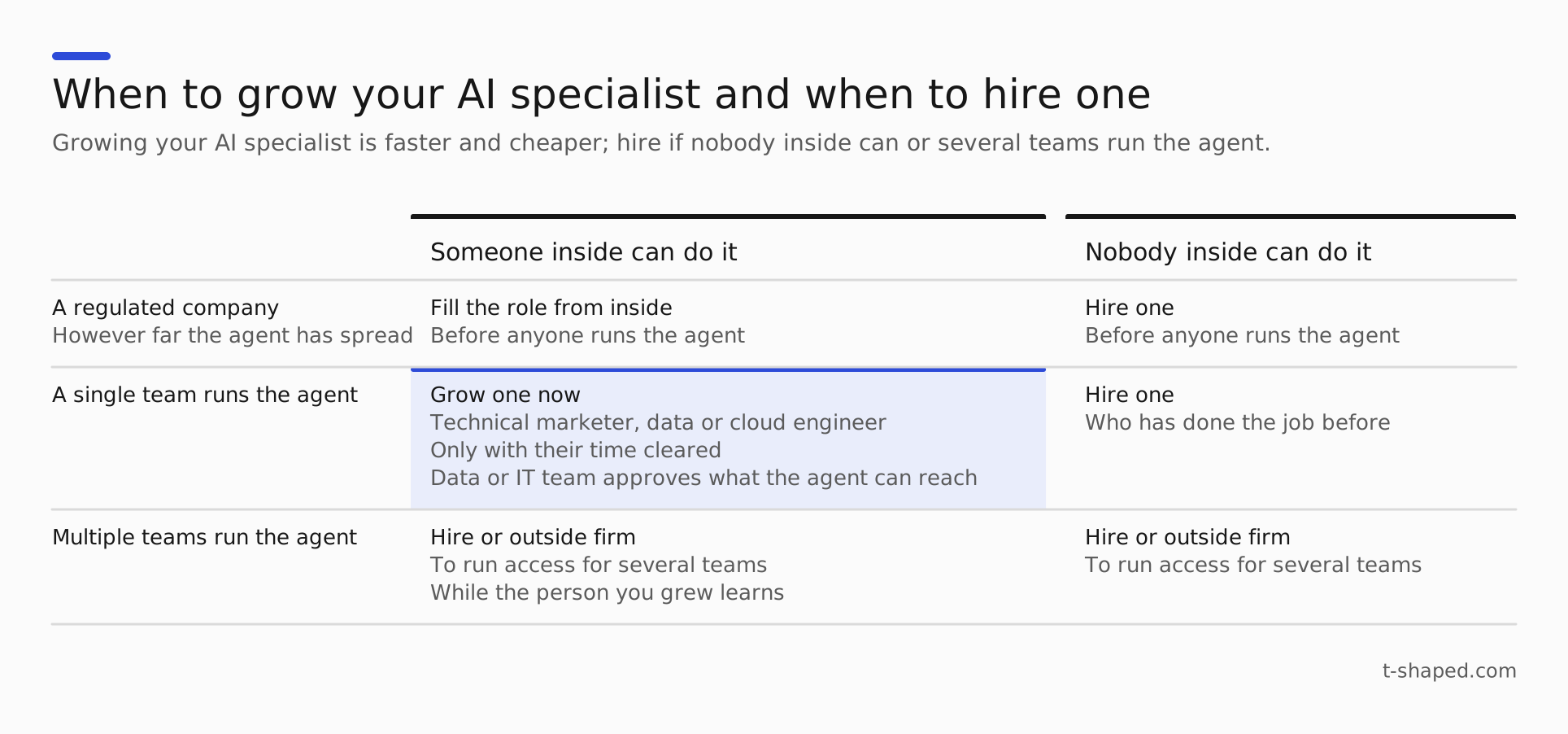
Grow your engineer or AI specialist from your existing technical teams if you can, because it's faster and cheaper than a search. Hiring someone who has done the job brings that experience on day one, but such people are scarce. In a Gartner survey of martech leaders last year, half cited a shortage of technical talent4. Hire when nobody on your technical teams can do it, or when large teams or an enterprise need specialized governance.
The route depends on how far the agent has spread and how regulated you are.
Download: SVG, PNG. Wider than the screen: swipe sideways, or download the PNG.
The field is still very new, which works in your favor. Curious, entrepreneurial technical people can learn it and keep up as it changes, but only if you clear their time and protect their focus from the day-to-day job. Start them on the AI companies' own courses. If you can afford it and need to keep pace, consider a small AI SWAT team that works on this full time.
Your first marketing agent should take on one recurring workflow
Build one marketing agent this way before you build a second.
Pick a first workflow that passes four tests:
- It recurs, so the builder gets many runs to judge.
- People want to hand it off, so they will use the agent.
- The output is quick to judge, so marks come back fast.
- It needs judgment a fixed rule cannot hold, such as explaining why spend is off plan.
A weekly performance recap across many accounts or channels passes. New creative concepts don't, because whether they work shows only after the spend.
Then, in order:
- Name the builder as the agent's owner, with a set review cadence.
- Protect the builder's time in writing.
- Grow an engineer or AI specialist from your technical teams, or hire one if nobody there can do it.
- Write the data rules and the test set.
- Get the agent approved access to its data and tools.
- Decide when the agent becomes the default, and close the old manual way, or the agent becomes one more thing to check.
Questions this piece answers
Who should build a marketing agent?
Pick the person who does the job best, because their time is spent once and the agent's quality repeats on every run. A new hire learns your playbook second-hand and can't always tell when the agent is wrong, and a junior team member is the wrong builder too.
What roles does a marketing AI team need to build agents?
A marketing agent needs a builder who has done the job hundreds of times and can write down the playbook, runners who use the agent day to day and give the builder feedback, and an engineer or AI specialist who keeps the agent within the company's rules on data and access. Over the longer term, they also own optimization, monitoring, and cost efficiency.
What does an agent builder do?
Before anyone else runs the agent, the builder writes three things: the skill, the data rules, and a test set of real past cases. After launch, they groom it, meaning they keep reviewing the output and refining the instructions.
Should I hire an AI engineer for marketing or grow one from my team?
Grow one from your technical teams if you can, because it's faster and cheaper than a search, and hire when nobody on your technical teams can do it. The field is still very new, so curious, entrepreneurial technical people can learn it and keep up as it changes, but only if you clear their time and protect their focus from the day-to-day job.
How do you stop a marketing agent from degrading?
Runners mark its outputs yes or no, with a reason on every no, and the builder acts on each no by improving the agent and its skills. The builder also rereads the whole skill against best practices instead of only patching bad outputs, and reruns the test set every time the model changes.
What should my first marketing agent do?
Pick a first workflow that passes four tests: it recurs, people want to hand it off, the output is quick to judge, and it needs judgment a fixed rule cannot hold. A weekly performance recap across many accounts or channels passes, and new creative concepts don't, because whether they work shows only after the spend.
Sources
- 1 Equipping agents for the real world with Agent Skills https://www.anthropic.com/engineering/equipping-agents-for-the-real-world-with-agent-skills
- 2 From Anatomy to Smells: An Empirical Study of SKILL.md in Agent Skills https://arxiv.org/abs/2607.01456
- 3 Building 90 AI Agents Inside a $2B ARR Marketing Team https://notes.nicklafferty.com/p/building-90-ai-agents-inside-a-2b-arr-marketing-team
- 4 Gartner Survey Finds 45% of Martech Leaders Say Existing Vendor-Offered AI Agents Fail to Meet Their Expectations of Promised Business Performance https://gcom.pdo.aws.gartner.com/en/newsroom/press-releases/2025-10-29-gartner-survey-finds-45-percent-of-martech-leaders-say-existing-vendor-offered-ai-agents-fail-to-meet-their-expectations-of-promised-business-performance
Notes on confidence
Every claim above was checked against its cited source on . Fourteen more sources in the research file were read for context and not cited:
- Agentic Marketing Engineer, Euromonitor International (job posting on Workable)
- Architect Marketing Agent Engineer, Airkit, part of Salesforce (job posting on the Accel portfolio job board)
- Agentic Operator, Growth Marketing, Ramp (job posting on the Redpoint Ventures portfolio job board)
- What nobody tells you about writing agent skills, PostHog (Product for Engineers newsletter)
- Why AI agent pilots stall before production, Bardeen
- Release: Report Finds UK Marketers Must Build Capability for 2026 AI Boom, Chartered Institute of Marketing
- Your Old-School Process Skills Are a Superpower for Building AI Agents, Asian Efficiency
- How to Hire AI Engineers in 2026: The Complete Guide, AY Automate
- The most AI-pilled CMO in tech shares his Claude setup, The Founder Brand (Executive Brand Podcast, Substack)
- European Marketing Agenda 2026: Beyond the Horizon, AI Adoption, Customer Experience, and Omnichannel Excellence as Drivers of Competitive Advantage, European Marketing Confederation
- Four role-based certifications for the people who put Claude to work for customers, Anthropic
- Claude Academy FAQ, Anthropic
- OpenAI Academy Courses, OpenAI
- Generative AI Leader, Google Cloud
Researched and drafted with AI assistance. Reviewed, edited, and approved by Scott Zakrajsek. Every claim is checked against its source. How the articles are made.