What is a marketing harness, and how do you build one?
Scott Zakrajsek, 22 min read.
- published
- updated
- last verified
- category
- AI and Agents
- format
- Paper, long-form
- built on by
- Agent Skills for Marketing Teams: Turning a Playbook Into Something That Runs (planned)Creative Review at Ten Times the Volume (planned)The Intelligent Brand: A Maturity Model for AI-Run Marketing (planned)Answer Engine Optimization: How Brands Get Recommended by AI Assistants (planned)One Platform, Many Brands: Running a Portfolio on Shared AI Infrastructure (planned)What Happens to the Agency Model When Agents Do the Production (planned)MCP, API, SDK, or CLI: How Should an Agent Reach Your Marketing Tools? (planned)
Key takeaways
- A marketing harness is everything in an AI agent except the model. It gives the model your brand knowledge, tools, and checks on every run.
- Faster AI drafts barely move launch dates with an unchanged approval chain. Turn objections reviewers repeat into checks each draft passes before they see it.
- Set guardrails (what agents can read, change, and send) in permissions and code. Turn brand rules and approved claims into files the agent reads.
- Six loops draft, check, route to reviewers, carry changes, record lessons, and fix the harness. Trust a separate checking agent that matches reviewers' past decisions.
- Own your rules and records, and rent the model and agent platform. Competitors get the same model upgrades, but not checks tuned to your reviewers.
- A marketing leader and an automation lead are responsible for the harness. Ask any vendor for records, starting with past cases rerun after each change.
- Start on one frequent workflow whose agents can't change any live system. Track its time from brief to delivery and its rounds of rework.
Key facts
- The international vocabulary standard for software engineering defines a test harness as code written to exercise other code before the code that will eventually call it exists, and a June 2026 survey of agent research credits the software engineer Mitchell Hashimoto and OpenAI with making harness engineering a settled term, and with describing an agent as model plus harness6, 7.
- In McKinsey's 2026 State of AI survey (McKinsey sells AI consulting), nearly three-quarters of high performers, the respondents who attribute 5 percent or more of EBIT to AI and report significant value from it, say they fundamentally redesigned workflows because of their AI use, against one-quarter of other respondents8.
- Gartner, the research firm, wrote in October 2026 that AI adoption by individuals and whole functions can improve productivity without fundamentally changing marketing performance9.
- Webflow, a website builder, wrote in April 2026 about its own marketing harness for governing agents; Salesforce announced an Enterprise AI Harness in September 2026; and Hightouch, a marketing software company, defined the harness in October 2026 as "the layer that coordinates the work and carries the context across your team's tools"18, 20, 19.
A marketing harness is everything in an AI agent except the model
Engineers who build agents use this definition, and it covers every part your team has to build and own.
A campaign spends weeks in review after the first draft
Take an invented example: a performance marketing team making paid social ads for one client and three audiences (new, lapsed, and current customers). The work runs in this order:
- Brief. The strategist writes a brief for each audience.
- Concepts. The client picks one of the creative team's ideas.
- Drafts. Copywriters write the copy, and designers make the images.
- Versions. The team adapts each ad to each audience and channel.
- Brand review. The client's brand lead checks each version.
- Legal review. The client's legal team checks every claim.
- Revisions. The team makes the changes and resubmits until both approve.
- Launch. The team sets the campaign live.
Boston Consulting Group gives an illustrative biopharma example from its consulting work1. The outline and agency brief take two to three weeks, as does creating the assets, which includes a first review1. Medical, legal, and regulatory review and revision take two to three more, and launch and performance monitoring about one week, 8 to 10 weeks in all1.
In a survey by the ad software company Smartly, 41 percent of more than 450 marketers in the US, UK, and Germany say it still takes three to four weeks to launch a digital campaign from asset creation to execution2.
Veeva sells content review software, and in that software at more than 350 pharma companies (November 2020 to January 2021), a piece typically spent six days in draft and an average of 15 in review3.
AI has made the drafting steps faster. A harness shortens the weeks of review and revision after the draft.
A harness lets a model work as an agent
A large language model is the kind of AI model behind ChatGPT and Claude. An AI agent is a large language model running in a loop with access to tools and data until a task is done. That cycle is the agent's own work, separate from a harness's six loops. Tools are the actions an agent can take in other software, such as pulling campaign results or pausing an ad.
Anthropic, which makes and sells the Claude models, defines an agent harness as "the system that enables a model to act as an agent"4. Birgitta Böckeler of Thoughtworks, the software consultancy, writes that harness has emerged as a shorthand for "everything in an AI agent except the model itself"5.
A harness is the onboarding your AI intern needs to do a good job
A model starts every task knowing nothing about your brand, your approved claims, or who signs off on what. So the harness gives it that knowledge, the tools, and the checks on every run.
The word harness came from software testing
The international vocabulary standard for software engineering defines a test harness as code written to exercise other code before the code that will eventually call it exists6. Harness engineering is the work of building the system around a model. A June 2026 survey of agent research credits the software engineer Mitchell Hashimoto and OpenAI with making it a settled term, and with describing an agent as model plus harness7.
A marketing harness needs more of your reviewers' judgment written down as rules than a coding one. Software has many checks with one right answer, such as tests that pass or fail. Marketing quality is mostly a judgment spread across many reviewers, and a sent email or spent budget can't be undone.
AI tools alone do not speed up marketing delivery
The gain comes when software runs the checks reviewers repeat on every draft, before the draft reaches them.
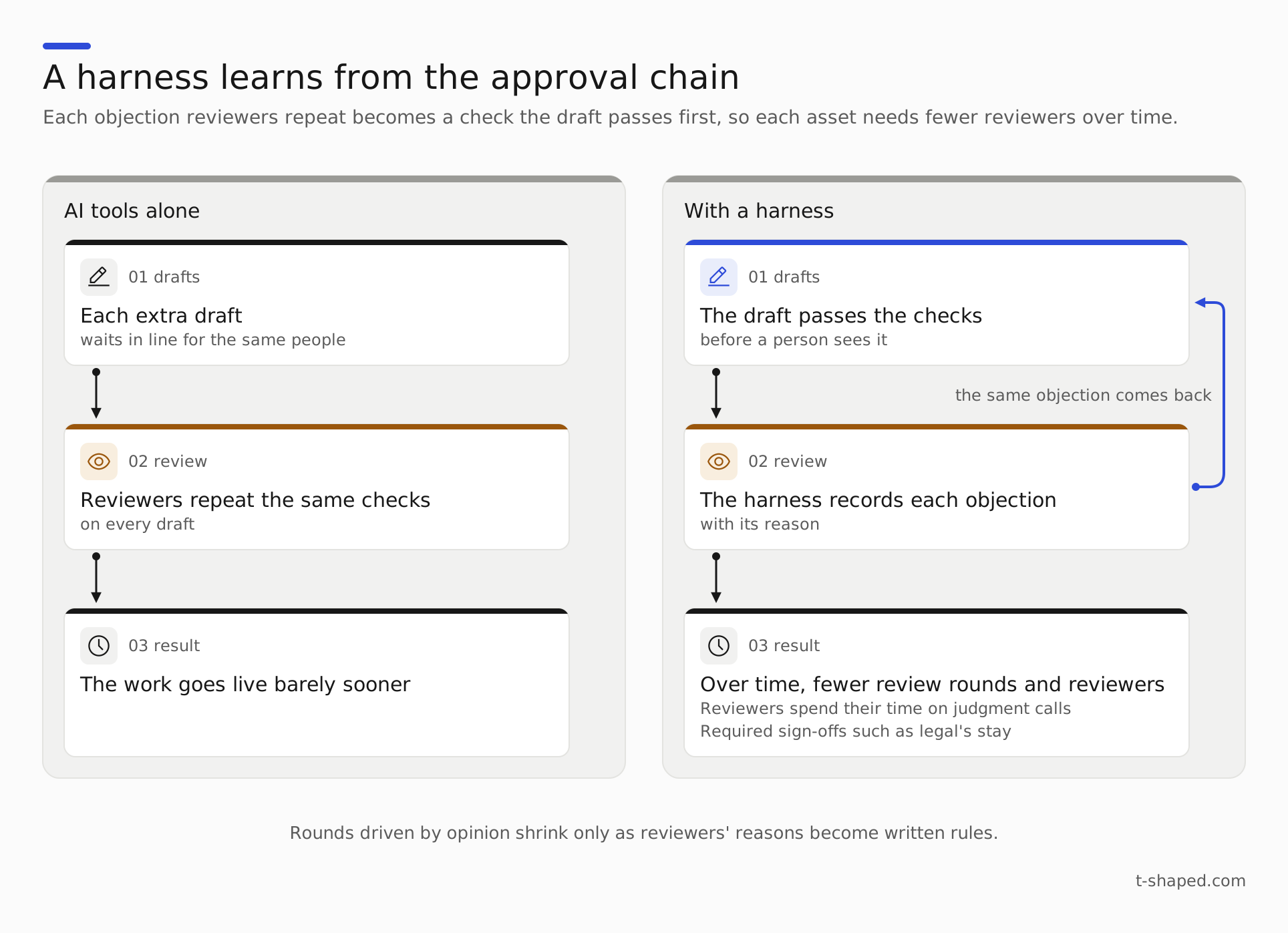
Campaigns, creative briefs, performance summaries, and creative assets pass through an approval chain, the people who sign off in turn before the work goes live. When AI produces more drafts, each extra one waits in line for the same people, so the work goes live barely sooner.
McKinsey's survey links results from AI to redesigned work
In McKinsey's 2026 State of AI survey (McKinsey sells AI consulting), high performers are the respondents who attribute 5 percent or more of EBIT (earnings before interest and taxes) to AI and report significant value from it8. Nearly three-quarters of them say they fundamentally redesigned workflows because of their AI use, against one-quarter of other respondents8. That links redesigning the work to results, without showing which caused which.
Gartner, the research firm, wrote in October 2026 that AI adoption by individuals and whole functions can improve productivity without fundamentally changing marketing performance9.
Marketing work takes several rounds of review and rework
- Veeva's 2026 survey of medtech leaders found 65 percent saying marketing assets now need three to five rounds of review10. Poor initial content quality and subjectivity in reviewers' assessments ranked equal as the top day-to-day bottleneck10.
- A survey by BetterBriefs, produced with the IPA (the Institute of Practitioners in Advertising), found that by respondents' own account it typically takes 5 rounds of creative development to get to a signed-off idea11.
Pharma and medtech are both regulated, so other brands may see fewer, shorter rounds. Count your own rounds in any pilot readout, not only the hours saved per asset.
Each objection reviewers repeat becomes a check the draft passes first
The strongest case against a harness is that McKinsey's finding points at redesigning the work, and redesigning an approval chain needs no AI. Cutting a redundant review step saves time right away. But it saves that time once, and the reviewers who remain still catch the same errors on every draft.
So map the chain first: who approves each piece of work, and what each approver checks. Some of those checks are objective gates, the items a reviewer checks the same way every time, such as a claim's exact wording or a required disclaimer. The harness records each objection with its reason. Once the same one comes back, it is written as a check the next draft runs.
Rounds driven by opinion shrink only as reviewers' reasons become written rules. As the checks prove they catch what reviewers used to catch, each asset goes through fewer review rounds and fewer reviewers. Reviewers spend their time on judgment calls. The marketing leader drops a reviewer's step once the checks catch what that reviewer caught on past drafts. Required sign-offs such as legal's stay.
Download: SVG, PNG. Wider than the screen: swipe sideways, or download the PNG.
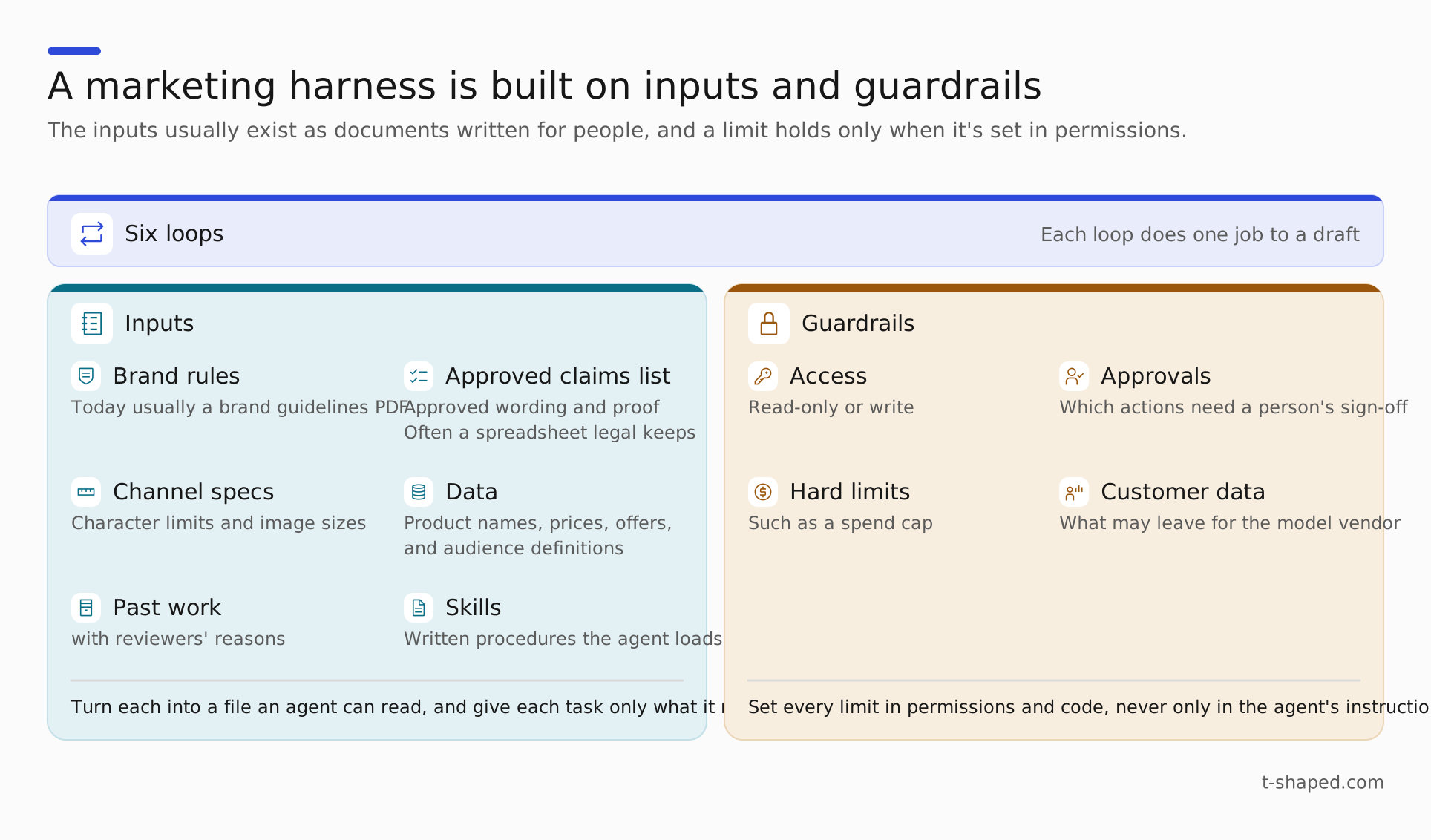
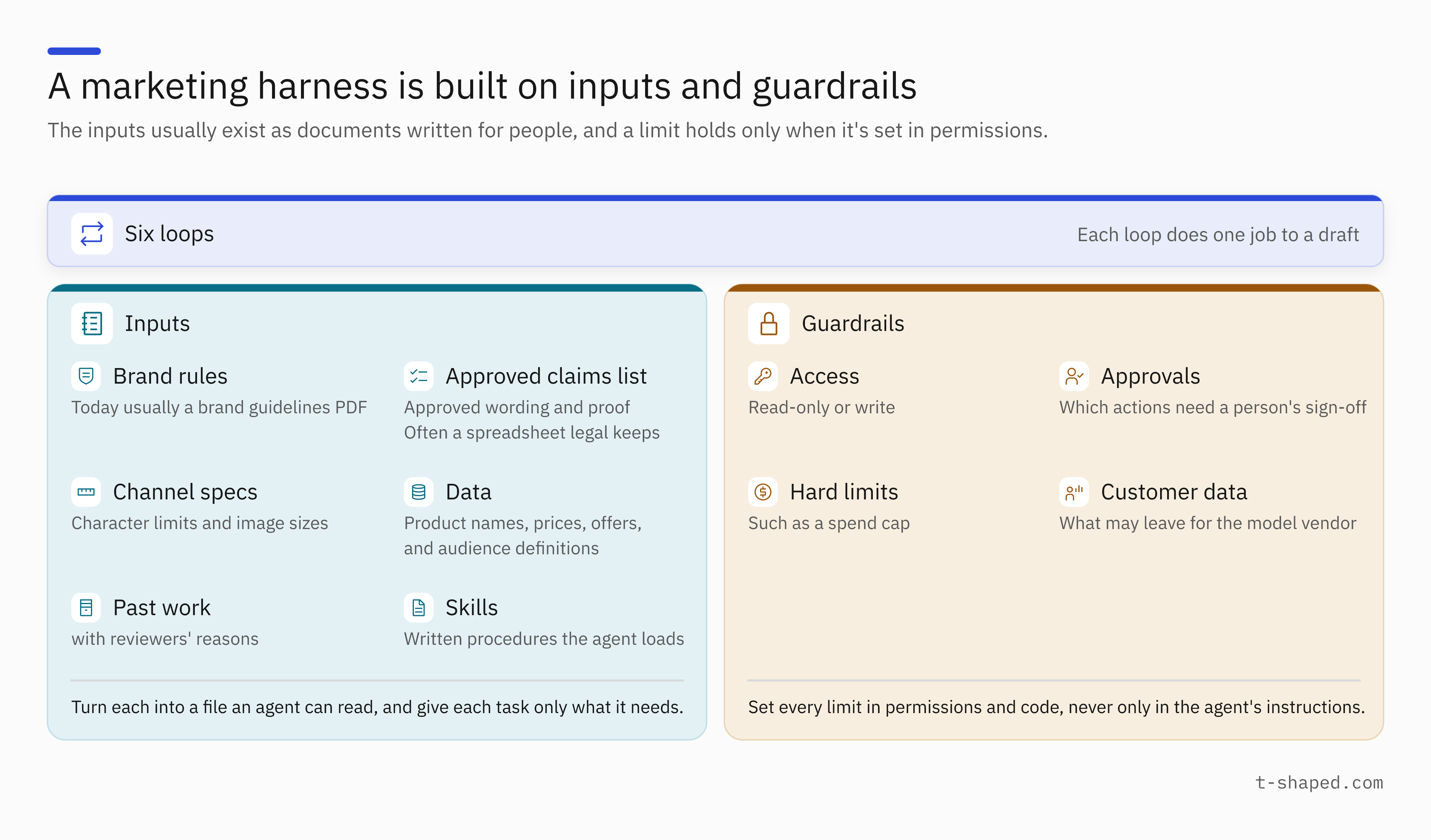
A marketing harness is built on inputs and guardrails
The inputs usually exist already as documents written for people, and a limit on an agent holds only when it's set in the system's permissions.
Inputs are the rules, claims, data, and skills an agent works from
An agent drafting marketing work needs these inputs:
- Brand rules, today usually a brand guidelines PDF.
- The approved claims list, each claim with its approved wording and its proof, often a spreadsheet legal keeps.
- Channel specs, such as character limits and image sizes.
- Data, such as product names, prices, offers, and audience definitions.
- Past work with reviewers' reasons, scattered across project management software, PDF comments, and inboxes.
- Skills. A skill is a written procedure, saved as a file, that the agent loads when a task calls for it.
The job is turning these into files an agent can read, then giving each task only what it needs. Anthropic says context, the information a model has in front of it while it works, is a finite resource, and each added piece of it helps less12.
Guardrails set what an agent can read, change, and send
Guardrails set four things for each agent:
- Access, read-only or write. Read-only lets an agent look at a system, and write also lets it change the system, for example by launching a campaign.
- Approvals: which actions need a person's sign-off.
- Hard limits, such as a spend cap.
- Customer data: which of it may leave your systems for the model vendor.
A connector gives an agent the tools for one system, often through the Model Context Protocol (MCP), a common way to link agents to other software. Give each agent a few tools shaped to its task. Anthropic reports that a tool set that covers too much, or leaves the agent unsure which tool to use, is among the most common failures it sees12.
Set every limit in permissions and code, never only in the agent's instructions. Today's models usually follow instructions, and "usually" is the problem when the action is spending budget or emailing customers. An agent can ignore an instruction, but it can't misuse a permission it doesn't have. If a system can't limit an agent's access, keep the agent out of it.
Download: SVG, PNG. Wider than the screen: swipe sideways, or download the PNG.
Rules for several brands, clients, or audiences sit in a hierarchy
If you work for several brands, clients, or audiences, store the inputs and guardrails as a hierarchy. Shared rules sit at the top, each brand's or client's rules under them, and each audience's rules under those. An agent on one client's brief reads only the shared rules and that client's and audience's rules. Permissions block every other client's material.
Six loops raise the quality and consistency of every draft
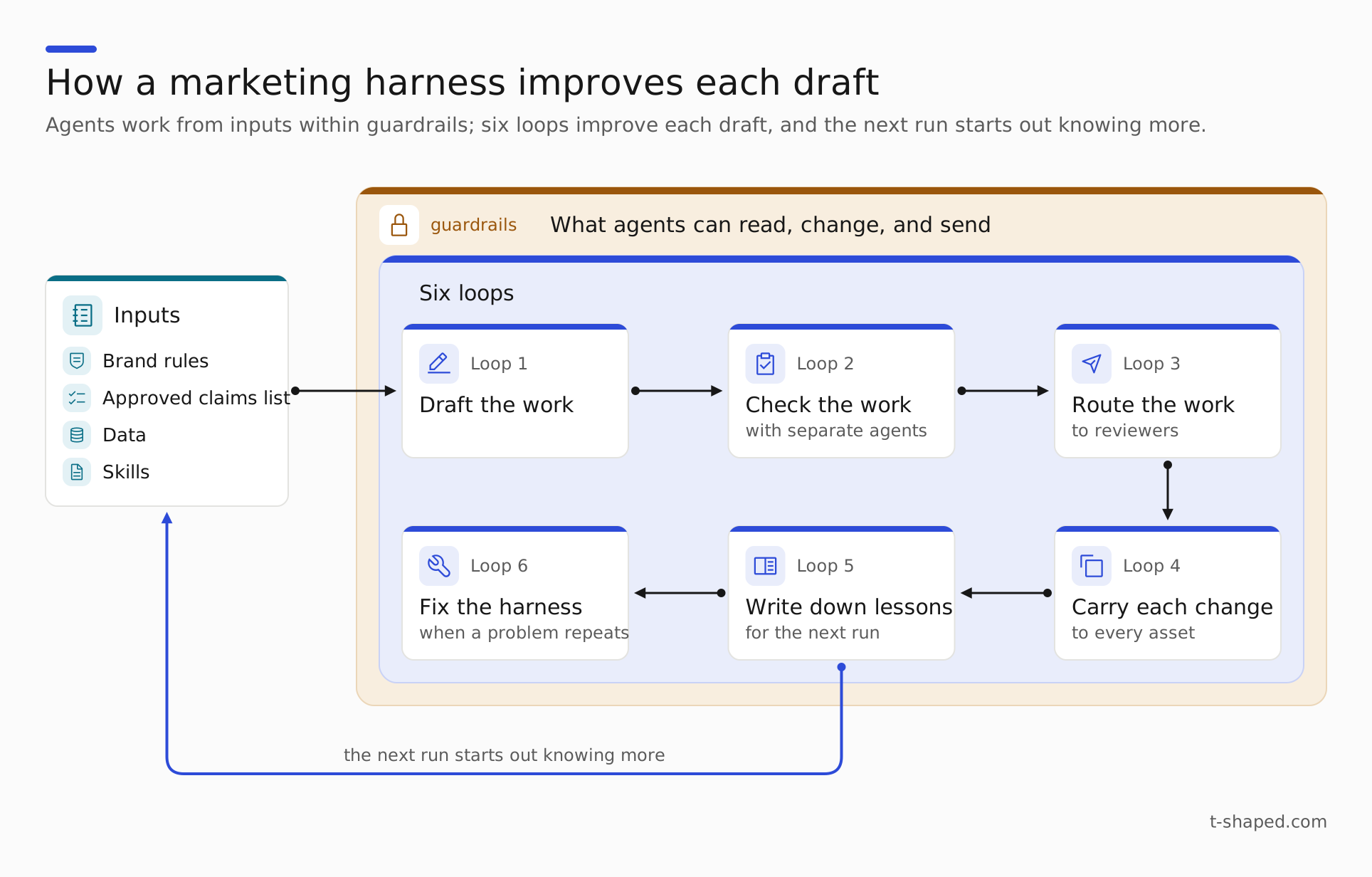
Each loop does one job to a draft and has a manual version your team may already run.
The illustration continues through all six loops, now with agents drafting the briefs and ads.
Loop 1: Draft the work
The drafting agent reads its inputs, drafts the work, compares the result with the task, and keeps going until the draft is done. The manual version is a copywriter working from the request, the brand guide, and past campaigns.
In the illustration: the drafting agent reads the client's request and each audience's rules. Then it drafts a brief and an ad, with copy and an image, for each audience.
Loop 2: Check the work with separate agents
Separate agents run separate checks, so the agent that drafted the work never grades it alone. Anthropic says agent evaluations typically combine three kinds of grading, by code, by a model, and by a person4. The person comes in Loop 3. Loop 2 uses the other two:
- Code checks what has one right answer, such as a character limit. When the drafting agent pulls each claim straight from the approved claims list, code can confirm the wording matches the list word for word.
- The checking agent, a separate AI agent, judges tone and brand fit. It also flags any other sentence that reads as a claim. The draft still goes on to the reviewers in Loop 3, and legal signs off on that claim there.
Anthropic reports from one engineer's experiments that agents reliably rate their own work too generously on judgment calls such as design13. A separate checking agent was far easier to make skeptical, though the engineer still had to correct its instructions several times before it graded reasonably13.
Do the same with your checking agent before you trust it. Run it on past drafts your reviewers approved and rejected, and correct its instructions until it agrees with them on both.
A model family is a set of related models of different sizes. Where you can, run the checking agent on a model from another family that is at least as capable as the drafting model. In one study on problems with right answers, such as math, a model checking work from its own family was biased toward accepting wrong answers14. In another, a model checking another model's work helped only when it was at least as capable15. Neither tested brand judgment.
When a check fails, the drafting agent fixes the draft and the checks run again. After a set number of tries, the harness hands the draft to a person with a list of what still fails. The manual version is a creative lead's checklist.
Download: SVG, PNG. Wider than the screen: swipe sideways, or download the PNG.
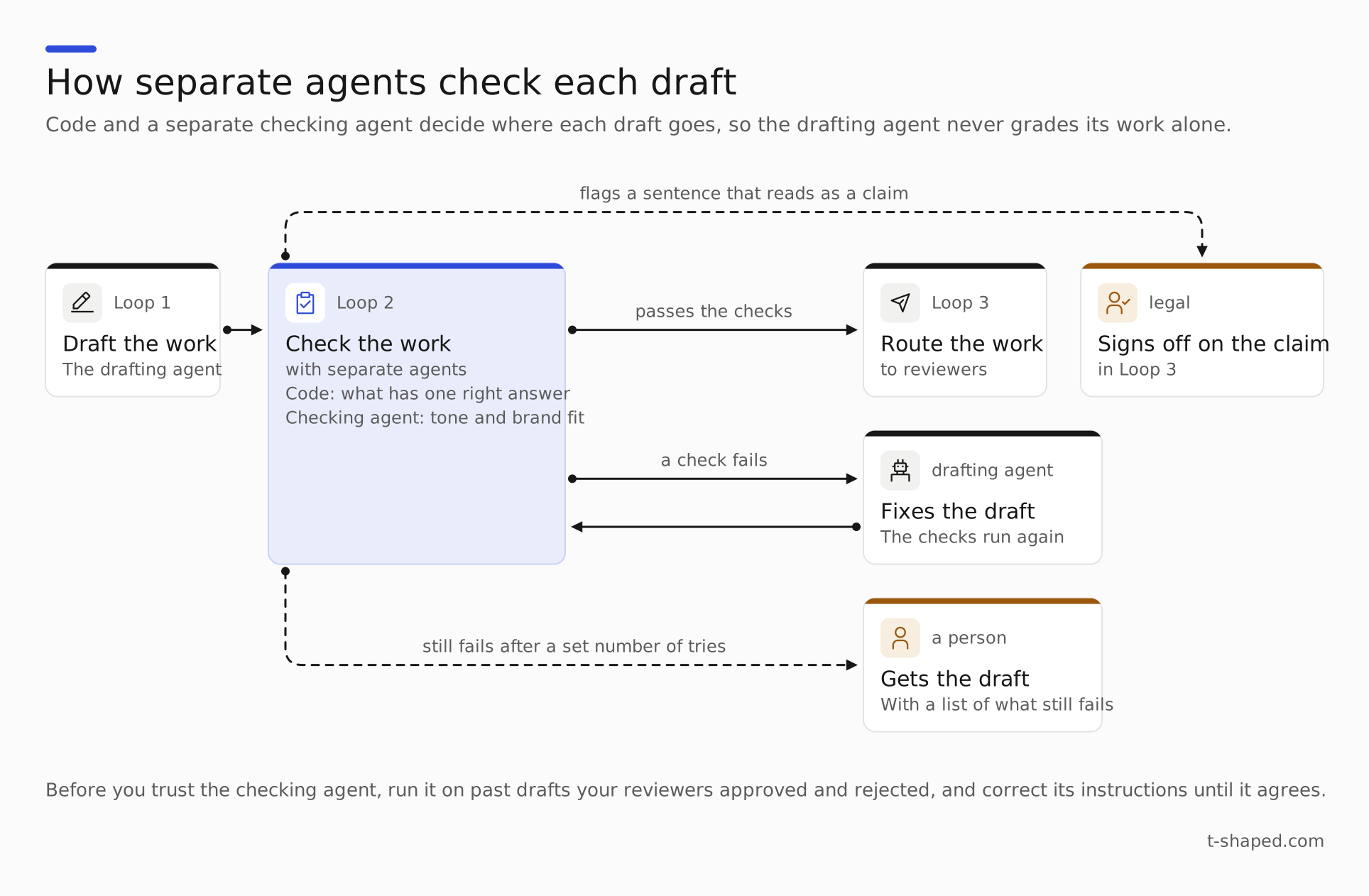
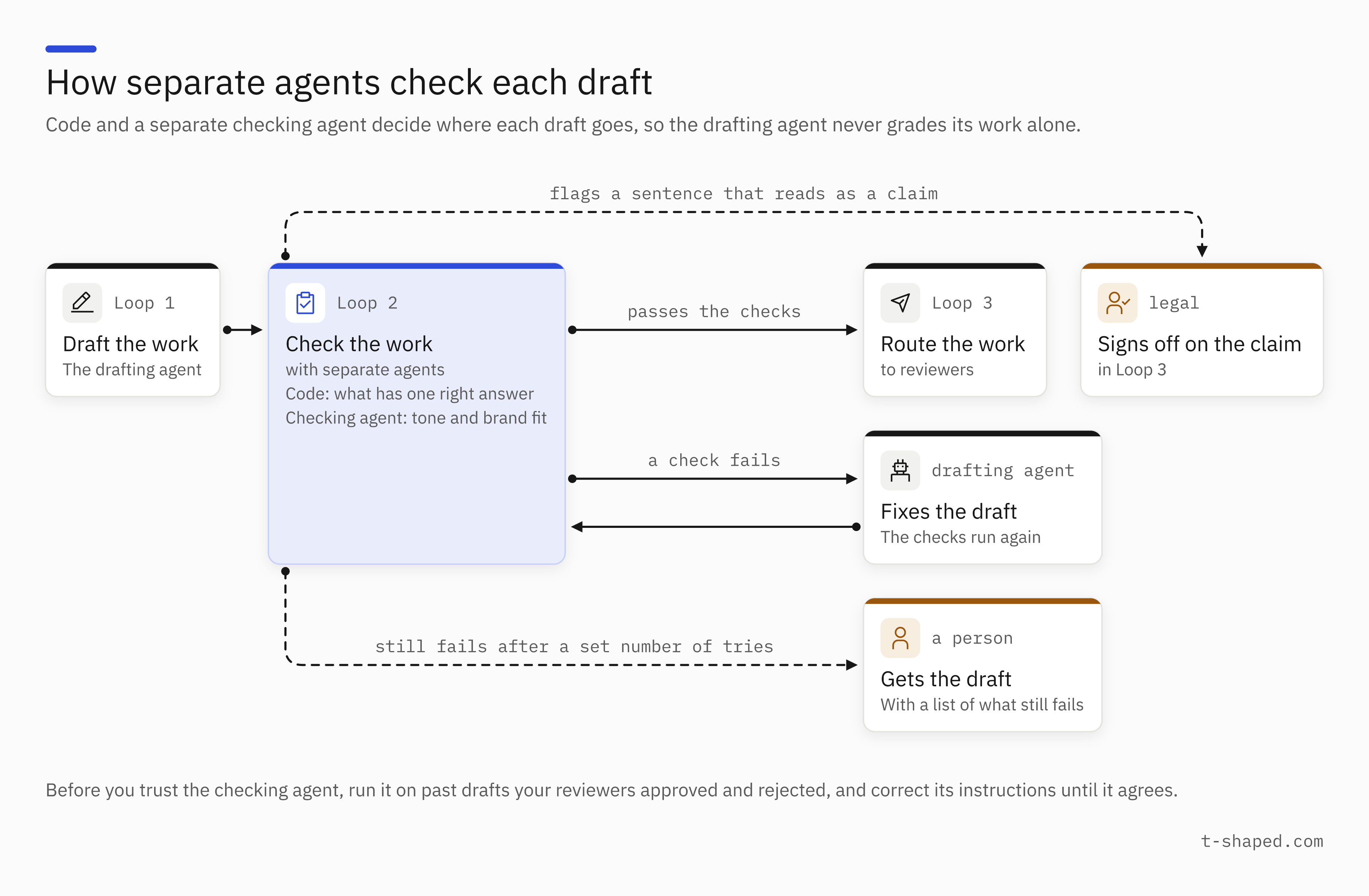
In the illustration: code catches a headline over the character limit and an offer that isn't among the client's approved offers. The checking agent flags one brief's tone and one claim the drafting agent worded its own way. The drafting agent fixes the headline, the offer, and the tone.
Loop 3: Route the work to reviewers
The harness sends each draft that passed the checks to the right reviewers and records every decision with its reason. The manual version is legal's redline on a PDF, where the reason stays in that file and no later draft reads it.
Legal will first say agents shouldn't write claims. In a working harness, the drafting agent's skill tells it to take claims only from the approved claims list, and legal still signs off on every asset. So legal sees every new or changed claim, which is more control than an email chain gives.
In the illustration: the team's strategist approves the briefs. The client's brand lead rejects one image, because the client always shows its product in use. The client's legal team approves new wording for the flagged claim, and that wording is added to the approved claims list.
Loop 4: Carry each change to every asset
When a claim, rule, or offer changes, the harness locates every brief and asset that used it and updates them. It reruns the checks and sends the changed versions to reviewers before anything live changes. That takes a record of which claims and data each asset used. The manual version is the brand team's email to every agency about a new disclaimer.
In the illustration: the harness swaps legal's approved wording into every asset that carried the agent's version, across all three audiences. It sends legal each changed asset with the new lines marked.
Loop 5: Write down lessons for the next run
The model behind your agent doesn't learn from a reviewer's note between runs. So this loop writes down what reviewers taught it, and the next run reads those lessons and starts out knowing more than the last one did. Anthropic describes agents writing notes to storage outside the model's context and reading them back later12. The harness keeps those notes in a lessons file. A lesson becomes a standing rule only when the person responsible for that kind of rule approves it, such as the brand lead for brand rules.
In the illustration: the brand lead's reason, that the client always shows its product in use, goes into the lessons file. Once the brand lead approves it, it becomes a client brand rule the next run reads before choosing images.
Loop 6: Fix the harness when a problem repeats
Loop 5 adds to what the agent reads. Loop 6 changes how the harness works: its skills, checks, and limits. Böckeler writes that whenever an issue happens more than once, the controls that steer and check the agent should be improved to make it less likely or prevent it5. The manual version is the review after a campaign ends.
Each failure also becomes a case in the test set. The test set is past cases with your reviewers' decisions and reasons, rerun after every change to the harness to show whether the change helped.
In the illustration: the brief-writing skill had not yet told the agent to take every claim from the approved claims list. So one claim reached legal in the agent's own words. The team adds that step to the skill and the case to the test set.
Most terms confused with a harness are its parts or systems it works with
A product sold under the name harness still has to show you each part working.
| Term | What it is | How it relates to a harness |
|---|---|---|
| The model | The large language model | The harness wraps it, and you can swap it |
| An agentic workflow | Models and tools run along steps fixed in code, which Anthropic calls a workflow; in an agent, the model directs its own steps16 | A harness can wrap fixed steps or let the model choose its own |
| An evaluation harness | The setup that runs tests and grades the results, in Anthropic's definition4 | Loop 6 uses one, and so does testing Loop 2's checking agent on past cases |
| An output filter (sold by some vendors under the name guardrails) | Software that blocks unsafe or off-brand text the model writes | One check a harness can run; a June 2026 paper says a guardrail is one piece of a harness, not the whole17 |
| A prompt library | Saved instructions for an AI assistant | Instructions with no checks, routing, or records |
| Your martech and customer data platform | The systems you already run campaigns on | The harness reads from and writes to them |
| An AI governance policy | A company's written rules for using AI | The harness enforces the ones that can be checked in code |
A harness lets software check rules marketing operations wrote for people
A marketing operations leader will fairly ask whether this is governance with a new name. Brand guidelines and content review software already hold the rules and route approvals. A harness adds software that runs those rules as checks on every draft, and a record of reviewers' reasons that the next draft reads.
Marketing software vendors took up the word harness in 2026
Each vendor describes it in terms of what it sells:
- Webflow, a website builder, wrote in April 2026 about its own marketing harness for governing agents18.
- Hightouch, a marketing software company, defined the harness in October 2026 as "the layer that coordinates the work and carries the context across your team's tools"19.
- Salesforce announced an Enterprise AI Harness in September 2026, drawing on technology from products it already sells20. The New Stack, a software news site, asked whether it is "cosmetic packaging" or a real simplification21.
Own your rules and records, and rent the model and agent platform
Your rules and records are what make the harness yours, and the model is a part you can swap.
Put everything your team writes for the harness in files your company controls and can export, and keep a history of every change. Three examples:
- Brand rules and skills as Markdown files, plain text with simple formatting marks, under version control, which keeps every past edit.
- The approved claims list as a CSV (comma-separated values) export, the plain spreadsheet format.
- Data definitions, the agreed meaning of each metric, product, and campaign field, wherever your data team keeps them, as long as they export as plain text.
Legal can keep the list where it is now, such as the review system that holds its sign-off record, if that system exports it.
Rent the model and the agent platform, the vendor software your agents and their loops run on, and the infrastructure under it. The harness is part owned and part rented: you own what it holds and rent the software it runs on. Write an export clause, on request and at exit, that names these files and every record the platform keeps, such as reviewers' decisions, lessons, and test runs. If the terms aren't negotiable, keep the files on your side and let the platform read them.
Download: SVG, PNG. Wider than the screen: swipe sideways, or download the PNG.
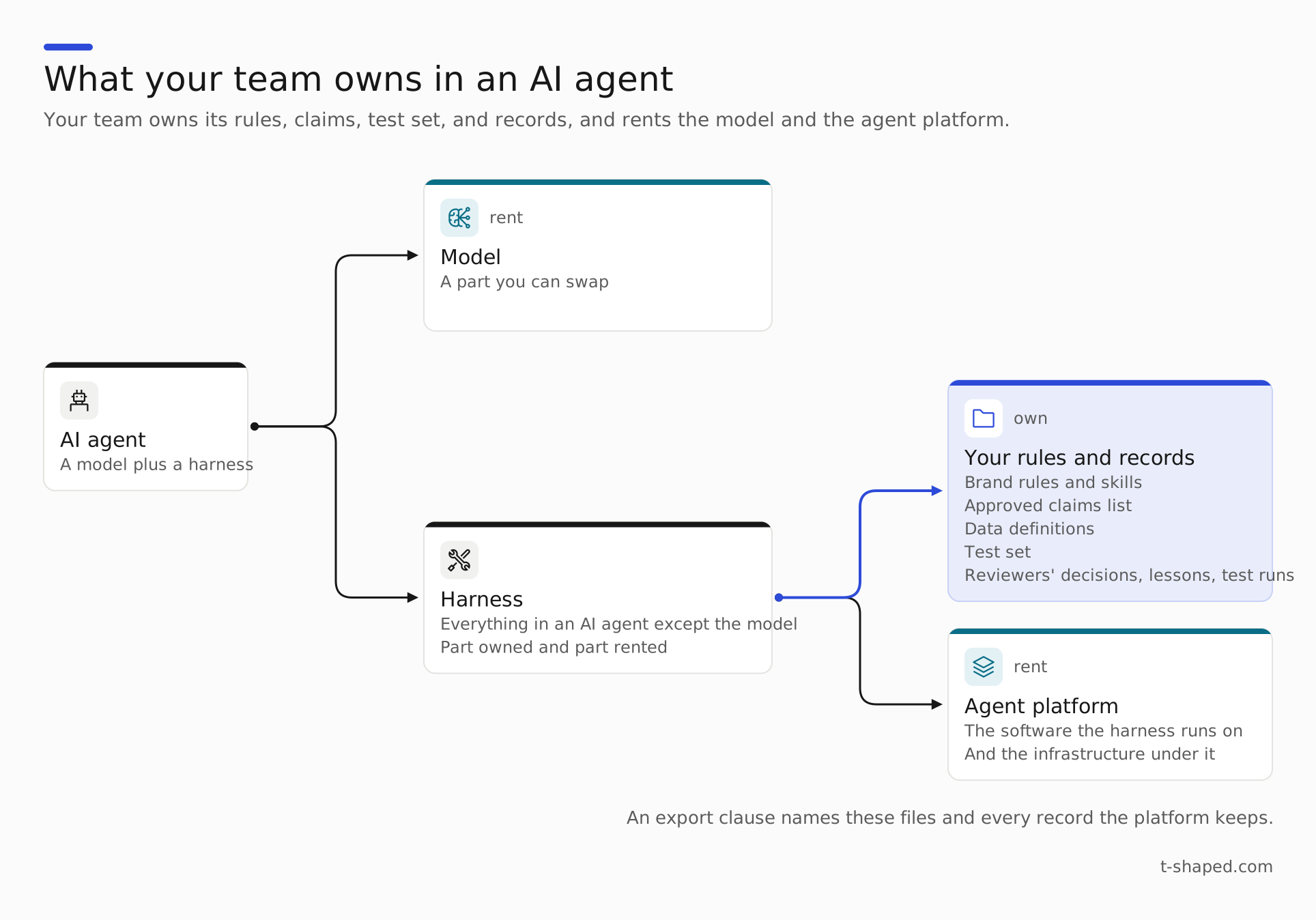
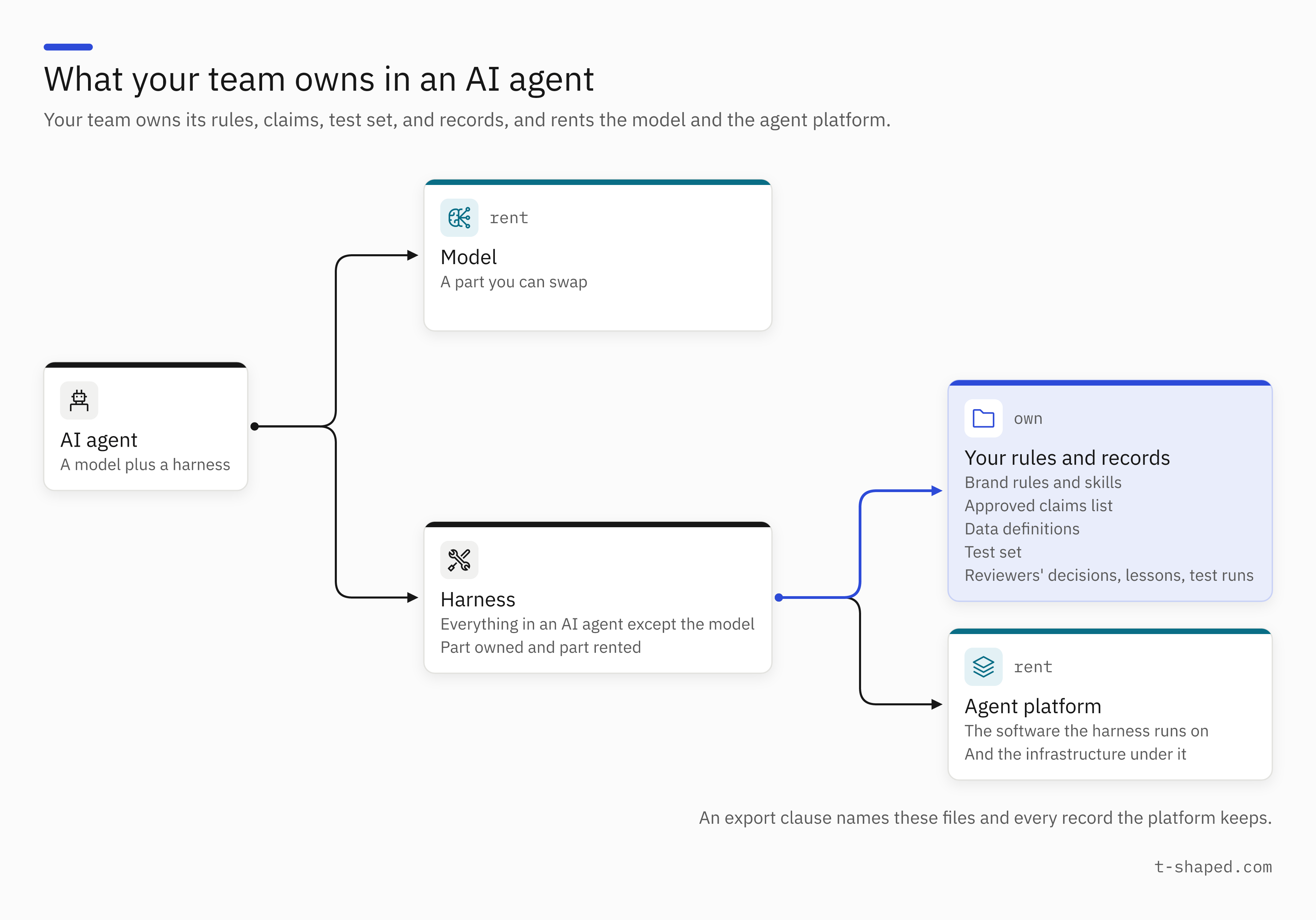
In December 2025 Anthropic published its skill file format, Agent Skills, as what it calls an open standard for moving skills between products22. Ask each vendor whether its product reads it.
If an agency builds or runs your loops, it works inside your permissions and approval chain. The agency's shared rules and skills stay the agency's. Your brand's rules, claims, reviewers' reasons, and lessons stay yours, and the export clause lists which files are which.
A model upgrade reaches every company renting the model at once
Better models do make some harness parts obsolete. Anthropic reports that its newer model, Claude Opus 4.6, made the checking agent in its experiment unnecessary for many tasks, though it still helped on the hardest ones13.
Checks can go stale that way, and the test set shows which ones to remove. Waiting still gives you no lead, because the same upgrade reaches every competitor who rents the model. Anyone can collect reviewers' reasons and test cases from past work. Checks tuned against your reviewers, and lessons from your own runs, come only from running the loops. So a brand that starts now with a modest model will be ahead of one that starts next year with a better one.
A marketing leader and an automation lead are responsible for the harness
Changing the approval chain takes someone with authority over marketing's process, and keeping the loops running takes someone who knows automation.
- The marketing leader knows the current process and has the authority to change it. They pick the next workflows and answer for the result.
- The automation lead has built automated workflows, documents how they run, and keeps the loops, checks, and records running.
Both need protected time for the harness written into their goals. On a small team, one person can hold both roles.
Grow the automation lead from your technical teams where you can, and hire one if nobody there can. Who builds marketing agents covers how to find that person.
Gartner advises CMOs to resolve unclear ownership, broken handoffs, and ambiguous decision rights in consequential, cross-functional workflows before assigning more work to AI9. For the harness, that's the marketing leader's job.
IT is the obvious alternative to a marketing leader, since it runs security and integrations. But the approval chain belongs to marketing, and only a marketing leader can change marketing's part of it.
Each team is responsible for its part of the harness
- Brand and marketing write the brand rules and the claims they want to make.
- Legal signs off on every claim in the approved claims list.
- The data team, or whoever builds your dashboards today, keeps the data definitions and the trail from each number back to its original source.
- IT sets permissions and security.
Brand rules, approved claims, channel specs, and the test set need no engineers. Connectors, code checks, permissions, and records need engineering time or a vendor.
Each role stops one task it repeats by hand
- Reviewers stop writing the same fix on every draft and write it once, as a rule.
- Designers stop checking each size against the channel specs by hand, because code does.
- Analysts stop reconciling numbers by hand and keep the data definitions the agents use.
The marketing leader tells the team the harness changes what people do and is not a headcount plan. The freed time goes into those rules and definitions, then the next workflow. Left unsaid, people will assume it's there to cut jobs.
Ten questions test any marketing harness, your own or a vendor's
A description of a capability is not evidence of it, so each question comes with a record to ask to see.
| Question | Record to ask to see |
|---|---|
| Has one workflow gotten faster, with less rework, since the harness started? | Runs from before and since the harness started, with their dates |
| Does the agent work from one source of truth, and can every number it uses be traced back to its original source? | The data definitions, and the trail for one number the agent reported |
| Are the brand rules and approved claims in a file the agent reads, and which live assets did the last change reach? | The file, its last change, and the assets it touched |
| What checks run before a person sees a draft, and does the checking agent agree with your reviewers' past approvals and rejections? | The checks, and the checking agent's grades beside your reviewers' decisions on past cases |
| Is there a test set, and when did it last run? | The test set and its last run |
| Where is each limit on spending, sending, and publishing set in code, and what happens when an agent tries to go past it? | The permission settings, and a record of a refused action |
| For several brands, clients, or audiences, how are the inputs and guardrails layered, and what keeps one client's material out of another's work? | The hierarchy, and a test that tried to cross it |
| Where are reviewers' reasons written down as lessons, and does the next run read them? | The lessons file, and a run that used it |
| If you changed vendors, what would you take with you, and in what format? | An export in open formats |
| Who is responsible for the harness, and what changed in it recently? | The two leads' names and the change log |
Ask a vendor about the test set first. It's the one record that tells you whether a change made the harness better or worse.
A bought product can pass all ten questions as well as one you build, since the questions test the records, not who built the harness. Before you buy, ask for those records from a trial on one of your workflows or from a customer running the product today. The more of the ten you can answer with a record, the closer you are to a working marketing harness.
A first marketing harness starts with one frequent workflow
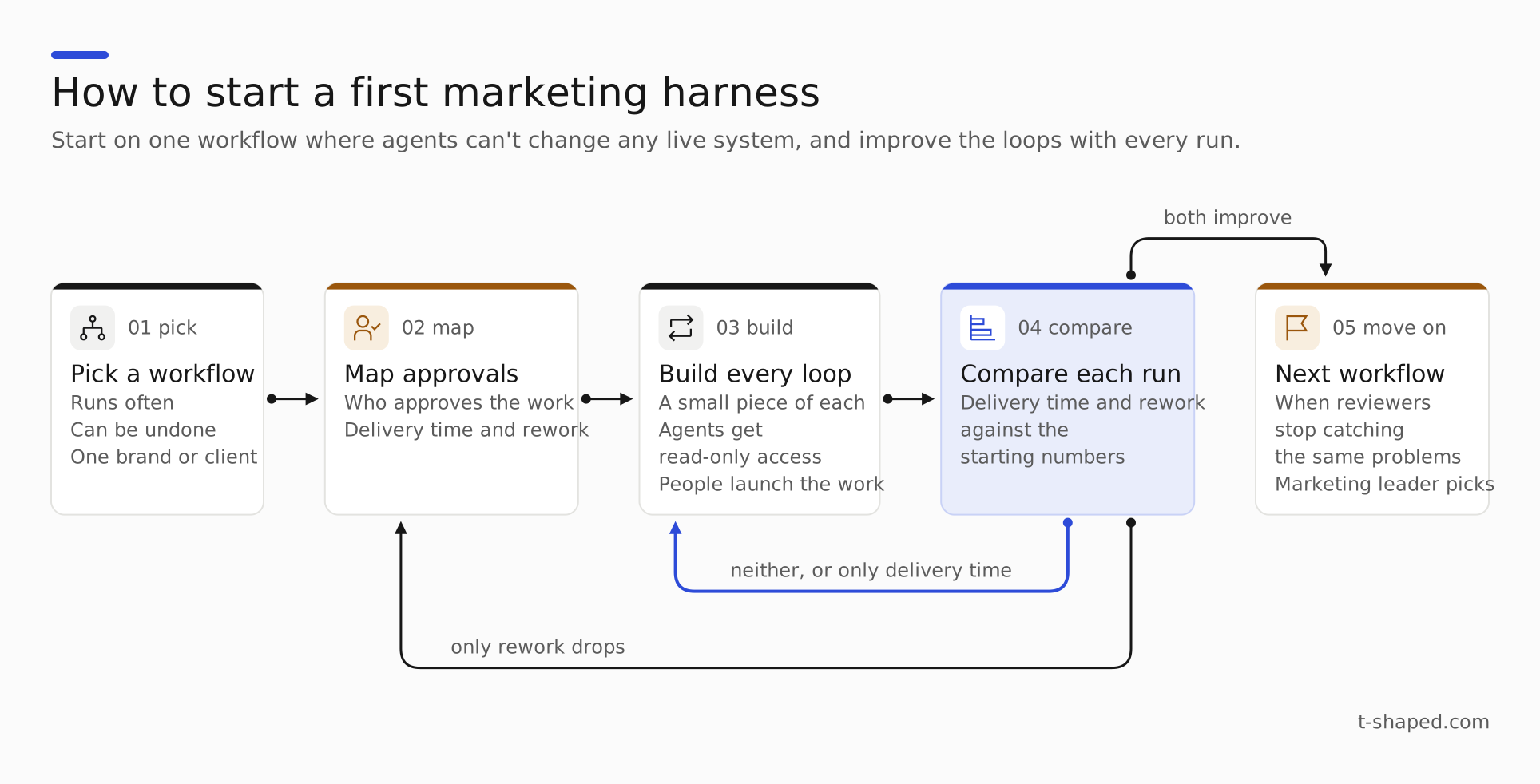
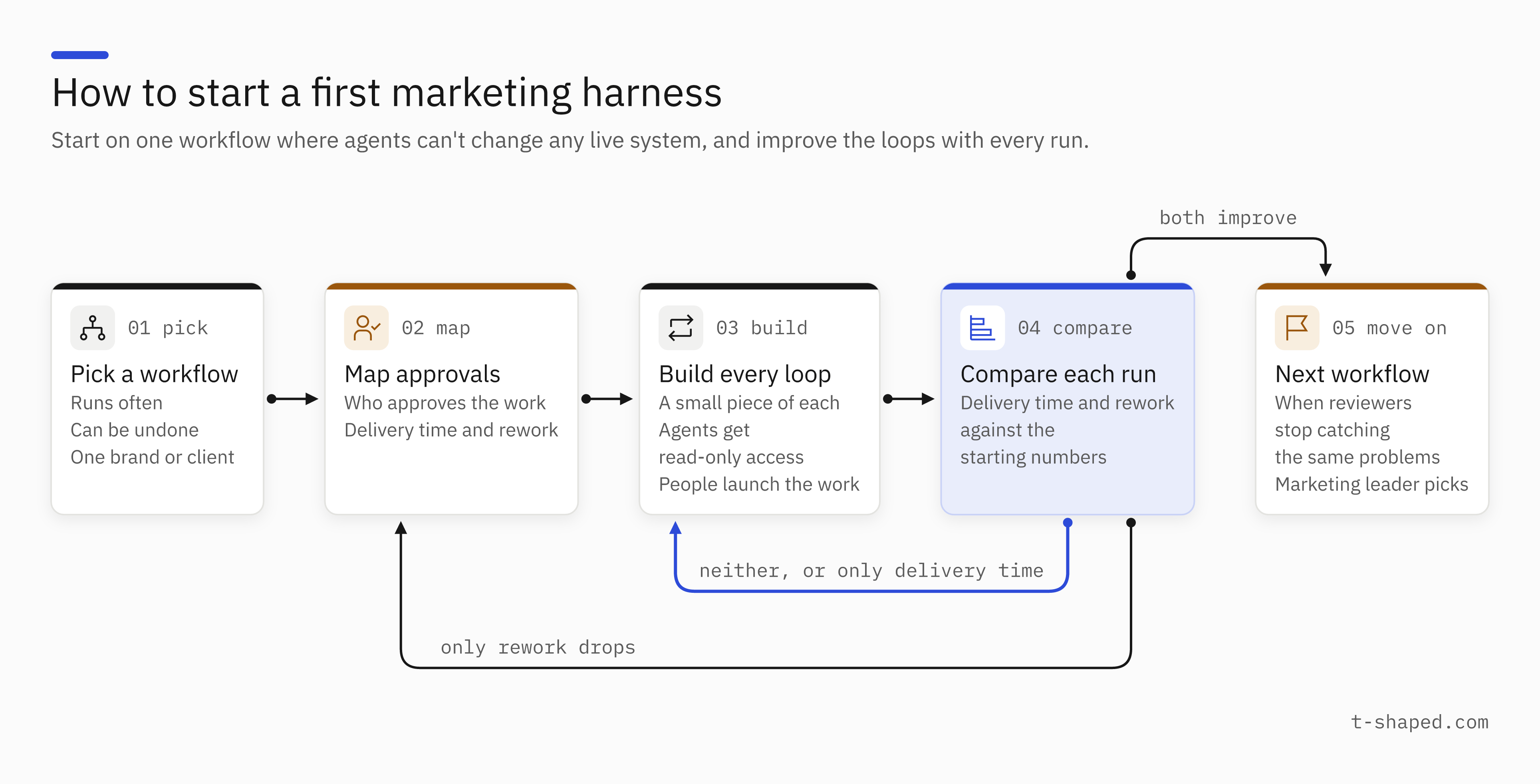
The first version will be rough, so start on one workflow where agents can't change any live system, and improve the loops with every run.
Pick a workflow that runs often and can be undone
The first workflow should pass these tests:
- It runs often.
- It has written rules a check can test.
- Its output can be undone.
- Its approval chain is short.
Good candidates are paid social briefs by audience, ad variants for one channel, and recurring performance summaries. A flagship launch fails two of these tests: it runs rarely, and its approval chain is the longest.
Start on one brand or client, since rules differ by brand.
Map the workflow's approvals and today's speed and rework
Before changing anything, the marketing leader and the automation lead pull the workflow's recent runs from your project management software or approval emails. From those runs, they map who approves the work and the objective gates each approval checks. For each run, they also write down how long it took from brief to delivery and how many rounds of rework it needed.
Each of the six loops starts as one small piece
Build a small piece of every loop at the same time:
- Loop 1: one skill for this workflow's brief.
- Loop 2: code checks for character limits and the approved claims list.
- Loop 3: a shared record of each reviewer's decision and its reason.
- Loop 4: a record of which claims each asset used.
- Loop 5: a lessons file that the next run reads.
- Loop 6: a test set from this workflow's past work, failures included.
While you test the loops, drafts go through your normal reviewers, and people launch them. The agents also log what they would have done, such as publishing an ad variant, beside what people actually did.
Give agents read-only access to the ad platforms through the permissions on the account each agent uses. Meta, which earns from ad spend, documents that its connector can create and edit campaigns23. Connectors change. Check each platform's current documentation.
The next workflow starts when rework and delivery time both drop
The automation lead compares each run's two numbers with the starting ones. When both improve and reviewers stop catching the same problems, the marketing leader picks the next workflow or brand.
If rework drops and delivery time doesn't, the wait is in the approval chain. Go back to the map of who approves what. If neither improves, or only delivery time does, what reviewers still catch shows which loop is weak. Repeated length errors point to the checks, and a repeated legal comment to the lessons file.
Download: SVG, PNG, MP4. Wider than the screen: swipe sideways, or download the PNG.
Agents get live actions one at a time
Once an agent's log matches what your people did, the marketing leader and IT can give it one live action at a time. Singapore's Infocomm Media Development Authority (IMDA), in its AI agent governance framework, recommends checkpoints that require human approval for high-stakes or irreversible actions, such as sending communications and making payments24. Sending and spending keep a person's approval, even after an agent takes other live actions.
Model usage grows with the checks that call a model
Code checks cost little to run, but the drafting agent, the checking agent, and every test set rerun call a model. Anthropic reports a coding experiment where the full harness cost over 20 times as much as one agent working alone, and the lone agent's app had a central feature that didn't work13. The trade is more model calls in exchange for fewer review rounds.
Questions this piece answers
What is a marketing harness?
Anthropic, which makes the Claude models, defines an agent harness as "the system that enables a model to act as an agent". A model starts every task knowing nothing about your brand, your approved claims, or who signs off on what, so the harness gives it that knowledge, the tools, and the checks on every run.
Why don't AI pilots speed up marketing?
When AI produces more drafts, each extra one waits in line for the same people in the approval chain, the people who sign off in turn before the work goes live, so the work goes live barely sooner. A harness records each objection with its reason, and once the same one comes back, it is written as a check the next draft runs, so each asset goes through fewer review rounds and fewer reviewers.
How is a marketing harness different from an AI agent or an agentic workflow?
An AI agent is a large language model running in a loop with access to tools and data until a task is done, and the harness wraps that model, so you can swap it. In an agentic workflow, models and tools run along steps fixed in code, and a harness can wrap fixed steps or let the model choose its own.
Should we build or buy a marketing harness?
A bought product can pass all ten questions as well as one you build, since the questions test the records, not who built the harness. The harness is part owned and part rented, so rent the software it runs on and put everything your team writes for the harness in files your company controls and can export.
How can I tell if a vendor's product is a real marketing harness?
Each of the ten questions comes with a record to ask to see, since a description of a capability is not evidence of it. Ask for those records from a trial on one of your workflows or from a customer running the product today, and ask about the test set first, since it's the one record that tells you whether a change made the harness better or worse.
How do you start a marketing harness?
Start with a workflow that runs often, has written rules a check can test, can be undone, and has a short approval chain, such as paid social briefs by audience. Build a small piece of every loop at the same time, and for each run write down how long it took from brief to delivery and how many rounds of rework it needed.
Sources
- 1 Executive Perspectives: Transformation through AI and GenAI, Customer Engagement https://www.bcg.com/assets/2024/executive-perspectives-ai-and-genai-in-customer-engagement-4dec.pdf
- 2 2026 Digital Advertising Trends Report https://www.smartly.io/digital-advertising-trends/2026
- 3 Commercial Content Trends Shaping the Future of HCP Engagement: 2021 Veeva Pulse Content Metrics Report https://www.veeva.com/wp-content/uploads/2021/06/Commercial-Content-2021-Pulse-Content-Metrics-Trends-Exec-Report-NA.pdf
- 4 Demystifying evals for AI agents https://www.anthropic.com/engineering/demystifying-evals-for-ai-agents
- 5 Harness engineering for coding agent users https://martinfowler.com/articles/exploring-gen-ai/harness-engineering.html
- 6 SEVOCAB: Software and Systems Engineering Vocabulary https://pascal.computer.org/sev_display/search.action?term=test+harness
- 7 From Question Answering to Task Completion: A Survey on Agent System and Harness Design https://arxiv.org/html/2606.20683
- 8 The state of AI in 2026: On the road to ROI https://web.archive.org/web/20261006063352/https://www.mckinsey.com/capabilities/quantumblack/our-insights/the-state-of-ai
- 9 Prepare Marketing Workflows for Human-AI Transformation https://gcom.pdo.aws.gartner.com/en/documents/8473045
- 10 2026 Medtech Commercial Content Benchmark Report https://www.veeva.com/medtech/wp-content/uploads/2026/07/2026-MedTech-Commercial-Content-Benchmark-Report-1.pdf
- 11 Global study highlights issues obstructing the development of creative ideas https://ipa.co.uk/news/betterbriefs-creative-ideas/
- 12 Effective context engineering for AI agents https://www.anthropic.com/engineering/effective-context-engineering-for-ai-agents
- 13 Harness design for long-running application development https://www.anthropic.com/engineering/harness-design-long-running-apps
- 14 When Does Verification Pay Off? A Closer Look at LLMs as Solution Verifiers https://arxiv.org/html/2512.02304v2
- 15 The Self-Verification Cliff: Generation Outpaces Self-Selection in Frontier LLMs, and It Widens With Capability https://icml.cc/virtual/2026/82529
- 16 Building effective agents https://www.anthropic.com/engineering/building-effective-agents
- 17 What makes a harness a harness: necessary and sufficient conditions for an agent harness https://arxiv.org/html/2606.10106
- 18 How Webflow’s marketing harness governs agents https://webflow.com/blog/marketing-ai-harness-context-layer
- 19 AI Marketing hasn't worked. You need a marketing harness to get sh*t done. https://hightouch.com/blog/marketing-harness
- 20 Salesforce Introduces the Trusted Enterprise AI Harness https://www.salesforce.com/news/stories/enterprise-ai-harness/
- 21 Six tools, one harness: Salesforce loops together a six-pack of favorites https://thenewstack.io/salesforce-enterprise-ai-harness/
- 22 Equipping agents for the real world with Agent Skills https://www.anthropic.com/engineering/equipping-agents-for-the-real-world-with-agent-skills
- 23 Ad creation and management https://developers.facebook.com/documentation/ads-commerce/ads-ai-connectors/ads-mcp-server/ads-mcp-server-tools-ad-creation-and-management
- 24 Model AI Governance Framework for Agentic AI, Version 1.5 https://www.imda.gov.sg/-/media/imda/files/about/emerging-tech-and-research/artificial-intelligence/mgf-for-agentic-ai.pdf
Notes on confidence
Every claim above was checked against its cited source on . In all, 25 more sources in the research file were read for context and not cited:
- Gartner 2026 CMO Spend Survey Finds CMOs Allocate 15.3% of Marketing Budgets to AI, But Only 30% Are Ready to Scale AI Capabilities, Gartner
- Moving the Agentic Marketing Transformation from Illusion to Reality, Boston Consulting Group
- AI Adoption Outruns Financial Returns, ICTbusiness.biz
- From AI experimentation to proven enrichment, Deloitte
- Australian marketing teams brace for more than 5X growth in content demand by 2027, Adobe
- Improving Deep Agents with harness engineering, LangChain
- The Anatomy of an Agent Harness, LangChain
- Quantifying and Mitigating Self-Preference Bias of LLM Judges, arXiv
- Large Language Models Cannot Self-Correct Reasoning Yet, arXiv
- Get started, Meta for Developers
- Introducing Meta Ads AI Connectors: Manage Your Meta Ads From the AI Tools You Already Use, Meta for Business
- Google Ads MCP server: Developer integration guide, Google for Developers
- Introducing the Amazon Ads MCP Server, the foundation for the next generation of advertising workflows, Amazon Ads
- Securing AI agents: When AI tools move from reading to acting, Microsoft Security Blog
- What Is an Enterprise Marketing Harness? The Operating Layer for Agentic Marketing, Gradial
- Writing effective tools for agents - with agents, Anthropic
- Specification, Agent Skills (agentskills.io)
- Built-in memory for Claude Managed Agents, Anthropic
- Transparency obligations under Article 50 of the AI Act, European Commission (Shaping Europe’s digital future)
- Measuring AI agent autonomy in practice, Anthropic
- Business and IT leaders report AI agents are scaling faster than their guardrails, Deloitte Insights
- Trade Regulation Rule on the Use of Consumer Reviews and Testimonials, Federal Trade Commission (Federal Register)
- Connect Claude Code to tools via MCP, Anthropic (Claude Code Docs)
- The 2026 AI and Marketing Performance Index, GrowthLoop
- Adobe research: 71% of marketers say the demand for content will grow 5X or more between now and 2027., Adobe
Changes since publication
Researched and drafted with AI assistance. Reviewed, edited, and approved by Scott Zakrajsek. Every claim is checked against its source. How the articles are made.