What is agentic media buying, and what can agents do today?
Scott Zakrajsek, 25 min read.
- published
- updated
- last verified
- category
- Media and Creative
- format
- Paper, long-form
- built on by
- Guardrails for Agents That Spend Money (planned)The Marketing Platform Connector Scorecard (planned)Meta's Ads AI Connectors: A Field Guide (planned)Google Ads and Agents: What Read-Only Gets You, and How Teams Add Writes Safely (planned)AdCP and Agent-to-Agent Buying: What the Open Protocols Mean for Media Teams (planned)
Key takeaways
- Pacing, routine edits, and reporting are weekly work an agent can take on. Where platforms set bids, the agent drafts edits to budgets and goals.
- Agentic media buying is an agent reading and changing ad accounts through a connector, a service that lists an ad platform's actions for AI software. Its tools and login set the limits.
- As of October 20, 2026, Meta's and Amazon's connectors change campaigns in open beta, and TikTok's can too. No other official connector does yet.
- Agent autonomy rises in five levels, from answering your questions to acting alone, and each level up needs more controls. Agree one level per task.
- Start read-only on pacing and quality assurance (QA) checks. Once the agent's explanations stop needing correction, it drafts routine edits for the buyer's sign-off.
- A person reviews and approves each budget shift between channels. The shift rests on margins and commitments no ad account holds.
- Make agencies and vendors prove agentic media buying on your account. Run their agent read-only, and compare its proposals with what your buyer would do.
Key facts
- Meta's Ads MCP server, in open beta announced April 29, 2026, creates and edits campaigns, ad sets, and ads; it creates every new campaign and ad set paused, and the AI assistant asks for confirmation before the tool ads_activate_entity switches one on and starts spending12, 13, 21.
- TikTok's Ads MCP Server, introduced May 13, 2026, creates and edits campaigns, ad groups, and ads, and its help page and launch announcement describe no approval step before a change goes live14, 16, 15.
- Amazon's Ads MCP Server, in open beta since February 2, 2026, can create, update, and delete campaigns, and the beta is for Amazon Ads partners with active API credentials27.
- The Google Ads MCP server searches metrics, budgets, and status, and lists accounts, and is read-only, with no bids, no pausing, and no new assets, per its guide updated October 16, 20267, 8.
- Researchers compared 663 randomized experiments at Facebook with two methods that estimate effects without a test, using richer data than most advertisers can access; for lower-funnel outcomes the experiments' median lift was 5%, while the other two methods put it at 24% and 64%42.
A brand plans paid media per campaign and typically runs it weekly
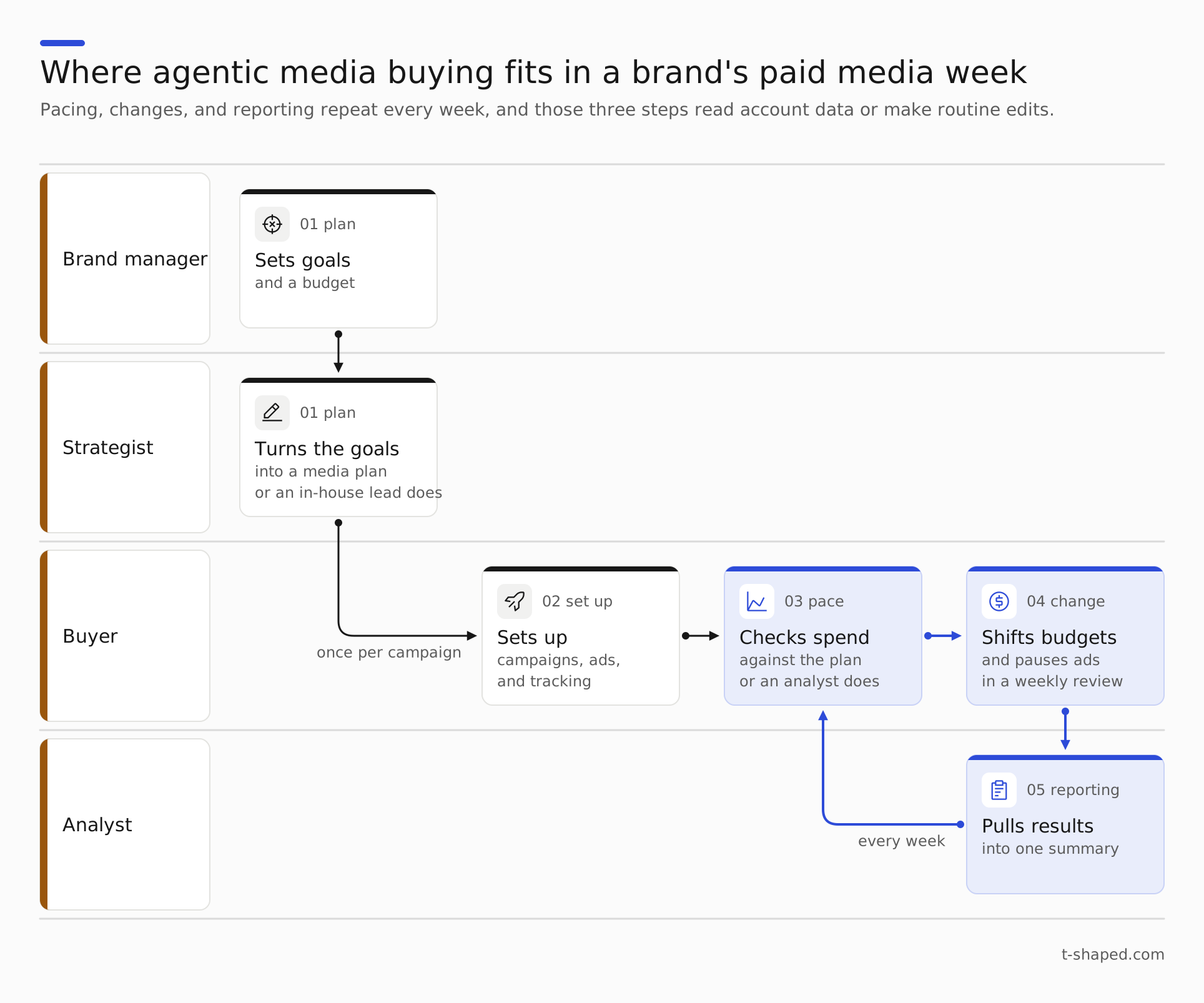
Planning and setup happen once per campaign, while pacing, changes, and reporting repeat every week, and those three steps read account data or make routine edits.
Each of the five steps has a usual owner
-
Step 1: Plan. The brand manager sets goals and a budget, and an agency strategist or in-house lead turns them into a media plan.
-
Step 2: Set up and traffic. The buyer builds the campaigns, audiences, ads, and tracking on each platform. Trafficking means loading the finished ads and their tracking tags into each system.
-
Step 3: Pace. The buyer or an analyst checks spend against the media plan, daily or several times a week. The State of PPC 2026 survey of pay-per-click (PPC) professionals, whose partners include PPC software sellers such as Optmyzr, reports that half of the 670 individual contributors and freelancers it asked track paid search budgets by hand1.
-
Step 4: Change. The buyer shifts budgets, adjusts target costs, adds negative keywords, and pauses ads that have stopped working, mostly in a weekly review.
-
Step 5: Reporting. The analyst pulls each platform's results into one weekly summary for the brand.
Download: SVG, PNG. Wider than the screen: swipe sideways, or download the PNG.
For an example CPG brand, the plan starts at the retailer
Retail media is the ads a retailer such as Walmart or Amazon sells on its own sites and apps. Each retailer's ad business is a retail media network. For a consumer packaged goods (CPG) brand, such as a snack maker, the retailers set the promotion calendar. It shows when the brand's products go on sale at each retailer. The brand decides how much to spend on each retailer's ads around those dates and times its social and search pushes around the biggest promotions.
This example is an illustration, not a client or a real company. A snack brand is in the weeks before a spring promotion at Amazon, one of its retailers, with paid media on Meta, Google, and Amazon. An agency buyer runs the campaigns, and an in-house analyst builds the weekly summary. The buyer also plans a new Meta campaign for the promotion's launch. Each morning, someone checks whether the promotion's spend is on plan on all three platforms, which is Step 3. This Monday, Amazon is behind plan. The buyer weighs a budget shift between Amazon campaigns, from those not spending their share to those that can.
An AI agent calls tools until a task is done
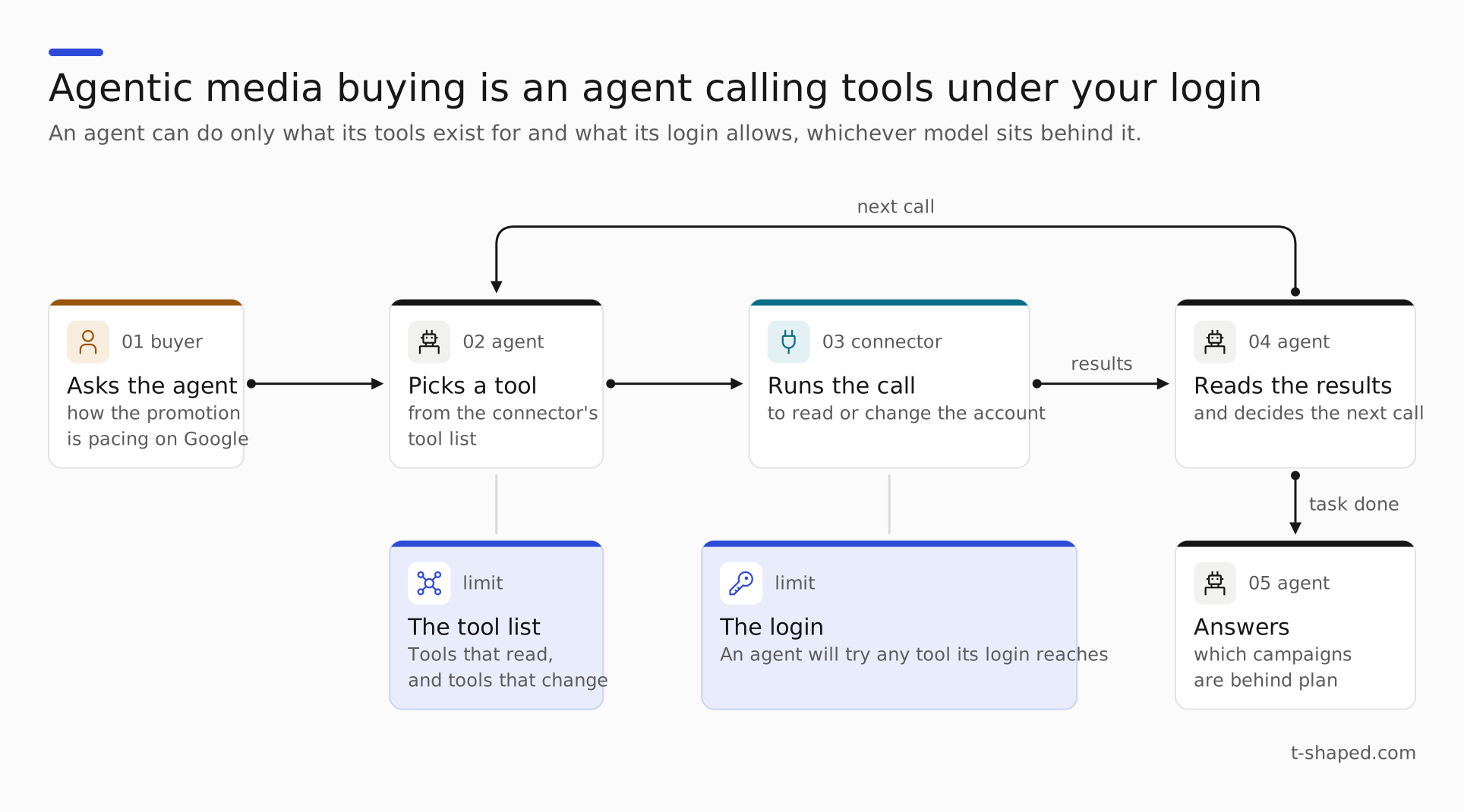
An AI agent is a language model, the kind of AI model behind ChatGPT, Claude, and Gemini, given a goal and a set of tools. A tool is one named action the model can take in another system, such as pulling yesterday's spend or changing a campaign's budget. The agent picks a tool, calls it, reads the result, and decides the next call until the task is done.
Automated bidding leaves budget allocation and goals to the buyer
Where a campaign uses the platform's automated bidding, the platform sets each bid, and an agent can check the settings the buyer still decides and draft edits to them inside one channel.
Buying moved from orders people negotiated, to auctions, to platform software that sets the bid. Direct sales run on insertion orders, signed orders for ad placements at a negotiated price. A 2017 academic survey of the field found that display ads were sold either in real-time auctions or in advance, and those sold in advance still mainly went through direct sales2. Google's AdWords was selling search ads by auction by February 2002, and display ad exchanges, marketplaces that auction each ad view to bidding software, followed around 20052.
Google's and Meta's automation picks bids and placements
Google's Smart Bidding sets a bid in each auction from the chance that the ad view leads to a conversion3. In Performance Max, Google's campaign type that serves one campaign across all of its inventory, the advertiser defines the conversions it cares about and an optional return on ad spend (ROAS) or cost per acquisition (CPA) target, which Smart Bidding works toward3. Google says the system moves budget toward the inventory and placements it rates highest3.
On Meta, a campaign counts as Advantage+, Meta's automated campaign setup, only when Advantage+ audience, Advantage+ campaign budget, and Advantage+ placements are all on4. Such a campaign sets no placement targeting or exclusions, which leaves every available placement eligible4.
The media buyer still sets budgets, goals, conversions, and creative
- Budget allocation, meaning how the total splits by channel, campaign, and tactic
- Goals and target costs, such as a ROAS or CPA target
- What counts as a conversion
- Campaign structure, meaning how products and audiences split into campaigns
- Audiences and exclusions, where the platform still allows them
- Bids, only where the buyer still sets them, such as keyword bids in retail media or campaigns on manual bidding
- Creative, the images, video, and copy
Where automated bidding runs, an agent leaves bids alone, because the platform sees far more data about each auction than an outside agent can. Meta's developer documentation says significant edits send an ad set back into the learning phase, when Meta starts counting the ad set's conversions again from that edit5. Results swing until the ad set leaves the phase, so limit how often the agent edits each ad set.
Agentic media buying is an agent calling tools under your login
An agent can do only what its tools exist for and what the login it runs under allows, whichever model sits behind it.
Three parts sit between a buyer's question and the ad account
-
The API (application programming interface) is the platform's way in for software: most of the same account data and settings as the web screens, reached by code.
-
The connector is a service that presents the API to a language model as a named list of tools, which the model can find and call on its own6. It follows the Model Context Protocol (MCP), a public specification for listing and calling tools6. Platform documents call a connector an MCP server, and an official connector is the platform's own.
-
The AI assistant is the app you type into, such as Claude, ChatGPT, or Gemini. The language model runs inside it as the agent. The account data the tools return lands there, under the AI company's terms for storing and using your data.
Agentic media buying is an AI agent reading and changing your ad accounts through a connector, under a login your team sets up.
Example: One question to the agent takes four steps
On Monday, the snack brand's buyer asks the agent how the promotion is pacing on Google. Google's guide for its Google Ads connector describes what happens next7:
- The model picks a tool. It picks the connector's search tool, which queries account data.
- The connector runs the query. It sends the request to the Google Ads API.
- The results return. They come back into the model's context window, the working text the model reads before it writes anything.
- The model answers. It writes the result in plain language, such as which Google campaigns are behind plan.
A tool that changes the account takes inputs such as the campaign and its new budget. The platform applies the change when the call arrives, unless the connector or AI assistant first asks a person.
The tool list and the login set the limits
- With sign-in set up, every tool request to Google's connector runs under the signed-in person's identity7.
- The MCP specification lets a connector show only the tools that a login's permissions allow6.
- Google's API has no access settings of its own and follows each login's user role in Google Ads, so a login that should only read gets Google Ads' read-only role8.
Set every login's access tightly before an agent connects. An agent will try any tool its login reaches. The account owner, the one person at the brand who answers for that account's spend even when an agency runs it, gives every login the narrowest role that does its job. A system user, a business-owned login that is not a person, gets the same.
Use the platform's official connector where one exists. Use a vendor's connector only for work no official connector covers, such as several retail media networks at once. A vendor's connector can write through Google's API, which accepts changes8. Don't add one to make changes where the platform's own connector only reads, as Google's does. The buyer makes every change there anyway, so the vendor's write access saves only typing and adds a company that holds your login. Vet a vendor's login handling and data terms as you would an agency's.
Repeated checks run steadier as API scripts
An API script is a short program that calls the platform's API directly and runs the same steps every time, with no model involved. An agent's answers can vary. Anthropic, which makes Claude, says identical inputs may produce different outputs even with the model's randomness setting at zero9.
Move a daily check, such as pacing, from the agent to an API script once its answers match the platform's figures and its steps stop changing, where your team or agency has access to the platform's API. The script writes into the team's own reporting, so the team and the script share one set of numbers. Keep the agent for work that needs judgment, such as explaining why spend moved or trying workflows that combine several tools.
A lean team's best reason to keep a repeated check with the agent is upkeep: a script is code someone has to fix when campaigns are renamed or the API changes, and nobody on staff reads code. The agent can redraft the script when that happens, and the analyst checks the script's output against the platform's own figures rather than its code.
Meta's and TikTok's agent connectors change campaigns, and Google's only reads
As of October 20, 2026, Meta's connector (in open beta) and TikTok's let an agent build and change campaigns, and no other platform in this table lets an agent change one yet.
| Platform | Official connector | What the connector can change | How access works | Status |
|---|---|---|---|---|
| Google Ads | Google Ads MCP server: searches metrics, budgets, and status, and lists accounts | Nothing: no bids, no pausing, no new assets | A Google sign-in or a service account, under the user role it holds in Google Ads8 | Read-only, guide updated October 16, 20267 |
| Microsoft Advertising | Microsoft Advertising MCP server, with tools that only retrieve data10 | Nothing | Read-only access | Read-only, in open flight (an open test), August 202611 |
| Meta | Ads MCP server | Creates and edits campaigns, ad sets, and ads | Facebook Login for Business, with the connector's permission (ads_mcp_management) plus read-only (ads_read) or full (ads_management) ad access12 | Open beta, announced April 29, 202613 |
| TikTok | TikTok Ads MCP Server | Creates and edits campaigns, ad groups, and ads14 | TikTok says only that no developer credential, API key, or coding is needed15 | Introduced May 13, 2026, for developers and advertisers building AI agents16 |
| Pinterest MCP | Nothing yet; Pinterest promises create and update tools | As of October 20, 2026, a sign-up list to "be the first to know when it launches"17 | Alpha with agency and software partners, announced June 17, 202618 | |
| Snap | Snapchat Ads MCP Server | Nothing at launch | An admin approves each AI assistant, then each user signs in | Live since August 3, 2026, read-only at launch19 |
| None found in its API docs, changelog, developer blog, or newsroom | Nothing | No connector | No connector found, checked October 19, 2026 |
Google and Microsoft let an agent read, and people make changes
Here the agent proposes new budgets for the snack brand's Google campaigns that are behind plan, and the buyer enters them in Google Ads. Google said in November 2025 that its own assistant inside Google Ads, Ads Advisor, can apply suggested changes once the advertiser reviews and approves them20. An outside agent working through Google's connector can't.
Meta and TikTok let an agent build campaigns that spend money
Meta's connector creates every new campaign and ad set paused, and the AI assistant asks for confirmation before the tool ads_activate_entity switches one on and starts spending21. That question comes from the AI assistant, and a user can turn it off for a tool. Anthropic tells Claude users to click "Allow always" only for a connector and tool they trust to run unsupervised22.
A second tool, ads_update_entity, changes existing campaigns, ad sets, and ads21. Meta's help article says any action taken on your behalf requires "your authorization through the AI agent" without saying whether that means each edit or only the connection23. The snack brand's agent builds the new promotion campaign through this connector. Switching it on spends money, so the buyer approves it first.
Meta lets a business set limits on what an agent creates and changes, in limited availability24. Each one blocks one agent action on one ad account or product catalog, such as "any budget increase above 20%"24. Meta's help article says Meta's connector enforces them, and a person with full control of the business portfolio, the Meta account that holds a company's ad accounts, sets them23. A partner given access to an ad account, such as an agency, can set its own limits there, which cover only the partner's own people23. Where an agency runs the agent, the account owner reviews the agency's limits too.
In Anthropic's published list of connectors for Claude, TikTok's connector lists tools such as smart_plus_campaign_create, which creates a campaign, and smart_plus_adgroup_budget_update, which changes an ad group's budget14. TikTok says agents can run whole workflows, from creating a campaign to adjusting bids, "without human intervention at every step"15. Its help page and launch announcement describe no approval step before a change goes live15, 16.
For TikTok Shop ads, TikTok offers an automation that TikTok says "automates end-to-end campaign creation and optimization"25. Its help page names no connector or API for it.
Expect a connector on every platform you buy on, perhaps read-only
Every connector in the table with a launch date came out in 2026, at least to a test group. Assume the rest will follow, to keep up with the platforms that have one and with the pressure on platform teams and agencies to adopt AI. Some may offer read access only and keep changes inside their own assistant, as Google does. Walmart Connect offers Marty, its own advertising assistant, in beta for Sponsored Search as of January 202626, and no connector.
Each new connector gets the same setup, with tight login roles and a read-only start. Until a beta ends, recheck the connector's tool list before giving the agent a new kind of task, because the platform can still change it. Meta's help article warns that "You may not have access to all of these tools and features yet"23.
Outside Amazon, retail media networks give agents read access or nothing
Of the retail media networks checked, only Amazon's official connector, an open beta for companies already on its ad API, lets an agent change campaigns, and Criteo's only reads27, 28.
| Retail media network | Official connector for agents | What the connector can change | Status |
|---|---|---|---|
| Amazon Ads | Amazon Ads MCP Server | Create, update, and delete campaigns | Open beta since February 2, 202627 |
| Criteo Retail Media | Retail Media MCP server | Nothing: no campaigns, line items, bids, budgets, or creatives28 | Criteo approves access for the whole company first29 |
| Walmart Connect | None found on its developer or ad sites, checked October 19, 2026; Marty, its assistant | Marty gives plain-language guidance and recommendations to plan, launch, and optimize campaigns | Marty in beta for Sponsored Search, January 202626 |
| Instacart, Kroger, Target's Roundel | None found in their developer documents or sites, checked October 19, 2026 | Nothing | No connector |
Amazon lets an agent create, change, and delete campaigns
Amazon's open beta is for Amazon Ads partners with active API credentials, meaning companies already set up on Amazon's ad API27. Amazon's guide shows how to switch individual tools off in the AI assistant, such as the tools that delete a campaign or an ad30.
The snack brand's shift between Amazon campaigns runs through this connector if the brand or its agency has access to Amazon's ad API. If not, the agent drafts it. The buyer then makes it in Amazon's console.
Skai's connector works across networks, and sales-data firms list no tools
A brand may also connect its ad software, or the sales-data firm that checks its ad spend against store sales:
-
Skai, a software company for running ads across retail media networks and other channels, launched Agent Connect on September 22, 2026, with 34 tools31. Skai says agents can use them to change campaigns, bids, and budgets, with every proposed change subject to human review31. Its product page lists preview and approval controls as coming soon32. Ask how that review happens today.
-
Circana (a sales-data firm) says its Liquid AI connects to AI assistants such as Claude and ChatGPT through MCP, and names no tool list, access terms, or status33.
-
SPINS (another sales-data firm) calls SPINS Foundry its data platform for agents and applications, but its September 2026 announcement names no connector or API to its sales data34.
Agent autonomy rises in five levels as human involvement falls
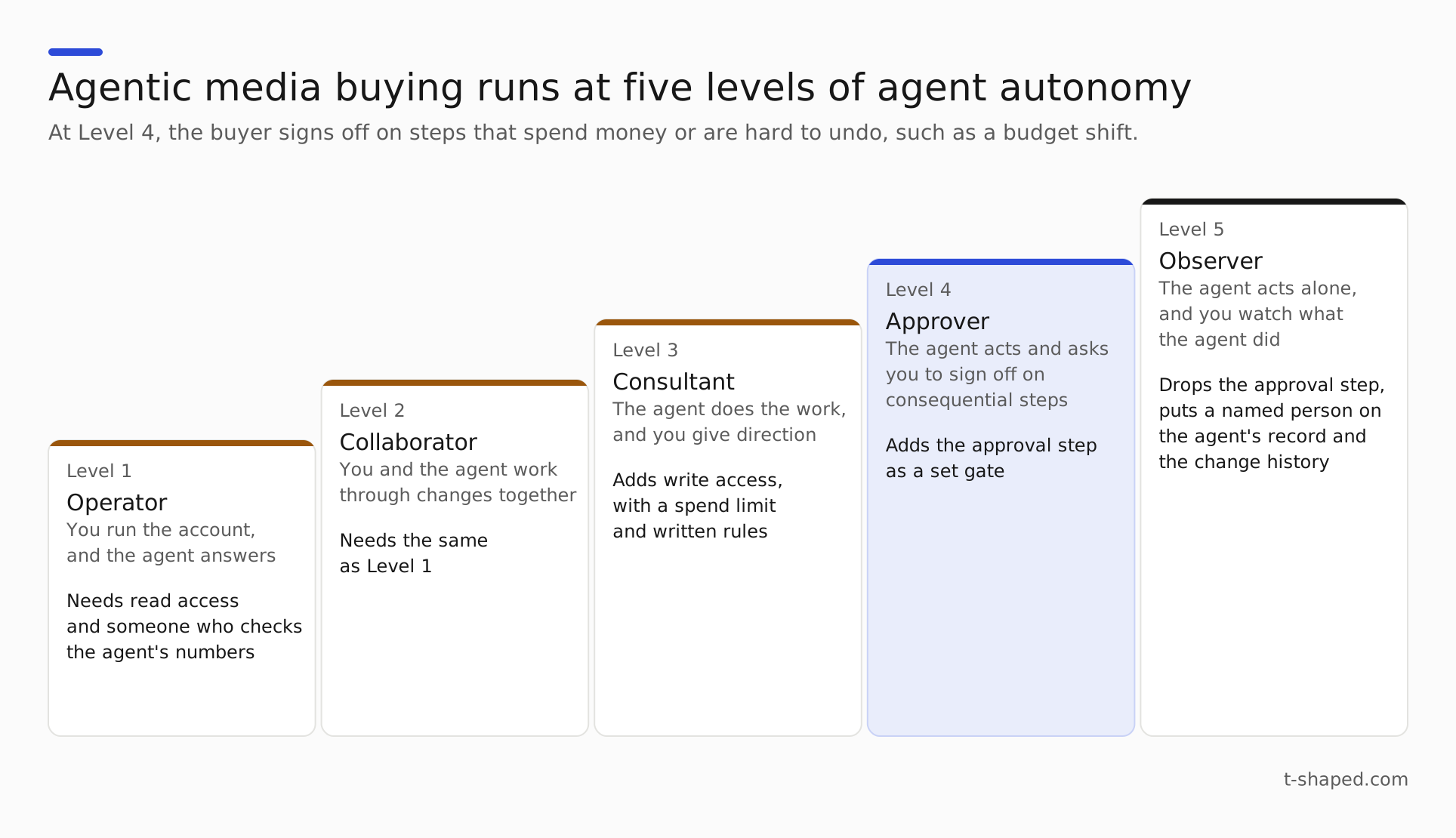
Any agent or pitch sits at one of five levels, from a person asking the agent questions to an agent acting alone while a person reads the record of its edits.
Researchers writing for the Knight First Amendment Institute at Columbia University name each level by the role the user takes, and treat it as a design choice separate from what the agent can do35. An agent that can change campaigns can still run at Level 1, where it only answers. Here are their five levels:
-
Level 1: You run the account, and the agent answers. You are the operator. You ask how the promotion is pacing on Amazon and act on the answer yourself.
-
Level 2: You and the agent work through changes together. You are the collaborator. The agent suggests a budget shift, and the two of you revise it.
-
Level 3: The agent does the work, and you give direction. You are the consultant and stay in the workflow. You set the goal, say which Amazon campaigns to favor, and agree to each step as the agent drafts and makes the shift.
-
Level 4: The agent acts and asks you to sign off on consequential steps. You are the approver, out of the workflow until a consequential step. A consequential step here is one that spends money or is hard to undo, plus any kind of edit the account owner has not yet cleared for the agent to make alone. The researchers note that an agent may find it hard to tell reliably which steps those are35. The shift between Amazon campaigns is one, and it waits for the buyer's sign-off.
-
Level 5: The agent acts alone, and you watch what it did. You are the observer. You can read a record of what the agent did, but not steer it, and the only control is an emergency off switch35.
Each level up needs more controls in place
Level 1 and Level 2 need read access and someone who checks the agent's numbers. Level 3 adds write access with a spend limit and written rules. Level 4 adds the approval step as a set gate, because you are no longer in the workflow to agree as the agent goes. Level 5 drops the approval step and puts a named person on the agent's record and the change history, the platform's record of each edit and who made it.
Download: SVG, PNG. Wider than the screen: swipe sideways, or download the PNG.
Hand an agent pacing and QA checks first, then routine changes
Pacing and QA checks change nothing, so they show whether the agent reads your numbers correctly before it may propose a change.
Start with the daily pacing sheet and three QA checks
At the snack brand, the first job is the analyst's daily pacing sheet: spend against the media plan by platform, built by hand. The second is three QA checks:
- Setup: each new campaign's budget, dates, targeting, and tracking match the brief.
- Changes: the buyer's intended edits landed, per each platform's change history.
- Running campaigns: the agent tells the buyer about any campaign that no longer matches the media plan.
Give both to the agent under a read-only login, and have it explain why spend moved. Once its sheet matches the platform's figures and its steps stop changing, move the sheet to an API script.
The agent reads the same numbers your team uses
Meta says the API the agent reads has different defaults from Ads Manager, the buyer's screen, except that since June 2025 the API follows Ads Manager's attribution settings36.
Give the agent one source of numbers: the team's own reporting, if it has one, where each metric is defined once and every number traces back to the platform's figure. Use the connector for what that source lacks, such as live settings, the change history, and edits. While the agent is read-only, the analyst checks each of its explanations against the change history and what the buyer knows happened. On a small team, the buyer holds that check. Once its explanations stop needing correction, the account owner lets the agent start drafting edits.
At Power Digital, an independent agency focused on data and measurement whose data team the author leads, agents today only read data and recommend, and a person makes every change in the ad platforms. The team is testing the action tools under tight controls.
Write the account's rules down before the first change
The account owner writes down:
- the spend limit for each campaign
- the campaigns the agent edits, and how often
- the campaigns it leaves alone, so no campaign has both a buyer and the agent editing it
- which changes need a buyer's sign-off
- the kinds of edit it can't make
- what it pauses, and what it never switches on
- who hears about each change
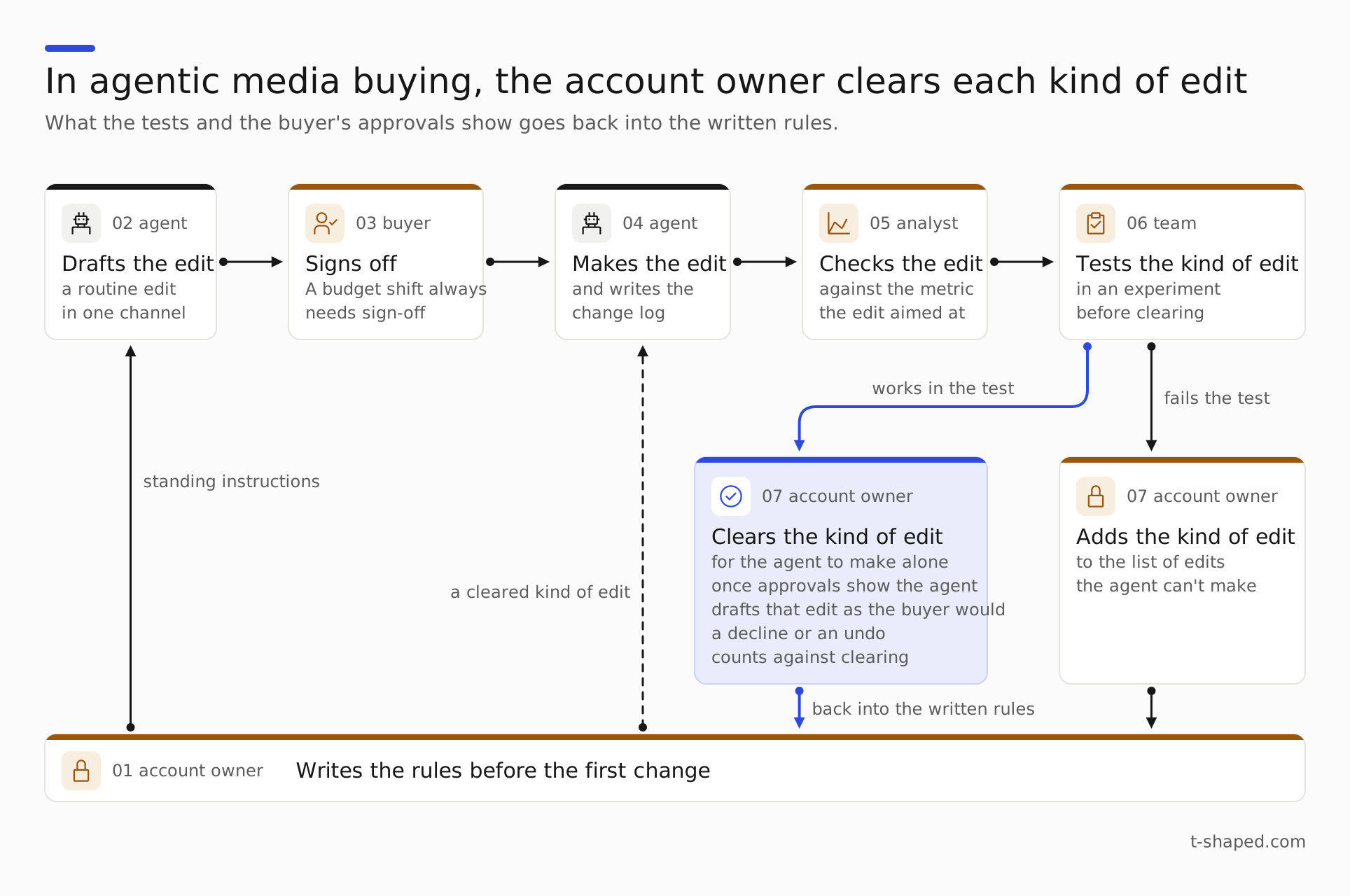
Those written rules reach the agent as standing instructions, the text the AI assistant gives it before every task. A language model doesn't always follow them. Set every limit the platform enforces too. On Meta, set its per-action limits where the account has them24. Meta's account spending cap stops every campaign in the account once reached, so set it above planned spend37. Where a platform enforces nothing, the login's role is the control.
Routine edits start with the buyer's sign-off on every one
Routine means an edit inside one channel that stays within the approved media plan, such as:
- adding negative keywords
- pausing ads that have stopped working
- shifting budget between ad sets that each have their own budget, never where the platform's automation sets that split
Each of these cuts delivery or moves money. At first the agent drafts it and the buyer signs off. The account owner clears a kind of edit for the agent to make alone only after the buyer's approvals show the agent drafts it as the buyer would and a test shows it works. Adding negative keywords and pausing ads can qualify, because each shows in the change history and is undone in one step.
A budget shift spends money, so it always needs sign-off. Each draft shows:
- the current and recommended settings
- the change in dollars and percent
- where the money comes from
- the review date, and how to undo it
Keep the sign-off even where a platform enforces limits, since a limit can't tell a good change from a bad one.
Every agent change is logged, and each kind of change is tested
Platforms record who changed what and when, not why. Meta's ads connector has a tool that reads the account's change history, which Meta calls the activity log38. The change event report in Google's API reaches back only 30 days39. The team keeps its own change log, which the agent writes as it acts: each action, its reason, and the settings before and after.
The analyst checks each routine edit against the metric it aimed at, such as spend on blocked search terms after a negative keyword. That shows nothing broke, not that the edit worked. When the check shows something broke, the buyer undoes the edit, and that counts against clearing that kind of edit, as a declined draft does.
Testing settles whether a kind of edit works. Google's experiment splits a campaign's budget or traffic between the original and a trial with the change40. An experiment takes weeks, too long to run on every edit, so the team tests each kind of edit before the account owner clears it.
What the tests and the buyer's approvals show goes back into the written rules, as the marketing harness article describes. A kind of edit that failed its test goes on the list of edits the agent can't make.
Download: SVG, PNG. Wider than the screen: swipe sideways, or download the PNG.
IT, legal, and finance object first, and each gets a control
-
IT and security ask where data goes and whether outside text could steer the agent. Anything it reads, such as a competitor's ad copy, enters its context window, and the model can follow instructions written there. Start read-only, keep agents that read outside text off write tools, and have IT check the AI company's data terms.
-
Legal asks what claims an agent could publish. Keep copy and new ads behind legal's usual claims review.
-
Finance asks who pays for media an agent wastes. The brand does, and Meta's terms from October 30, 2026 make the advertiser "solely responsible" for third-party software it uses or authorizes41. The controls are spend limits, one named account owner, and an agency contract naming what the agency covers.
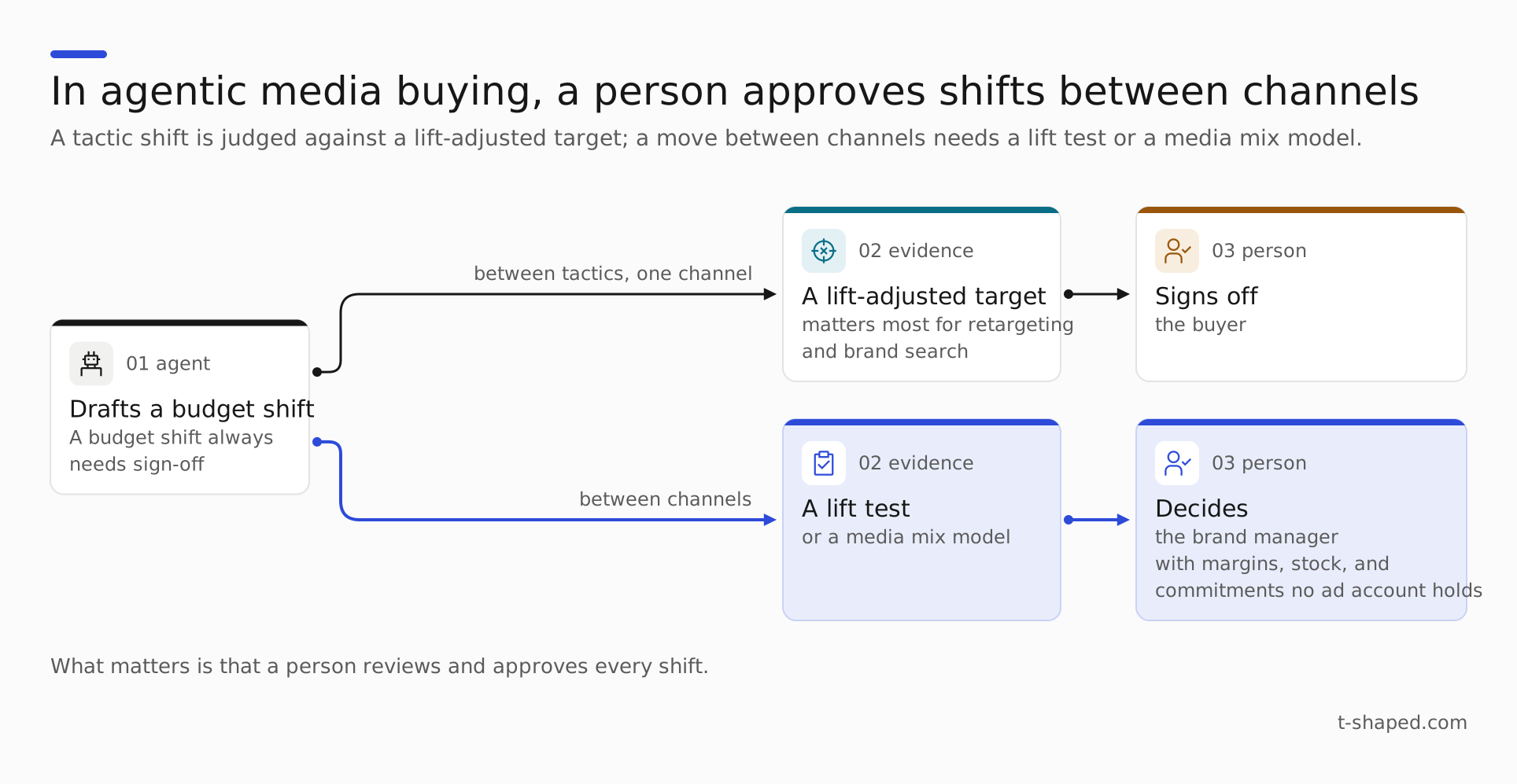
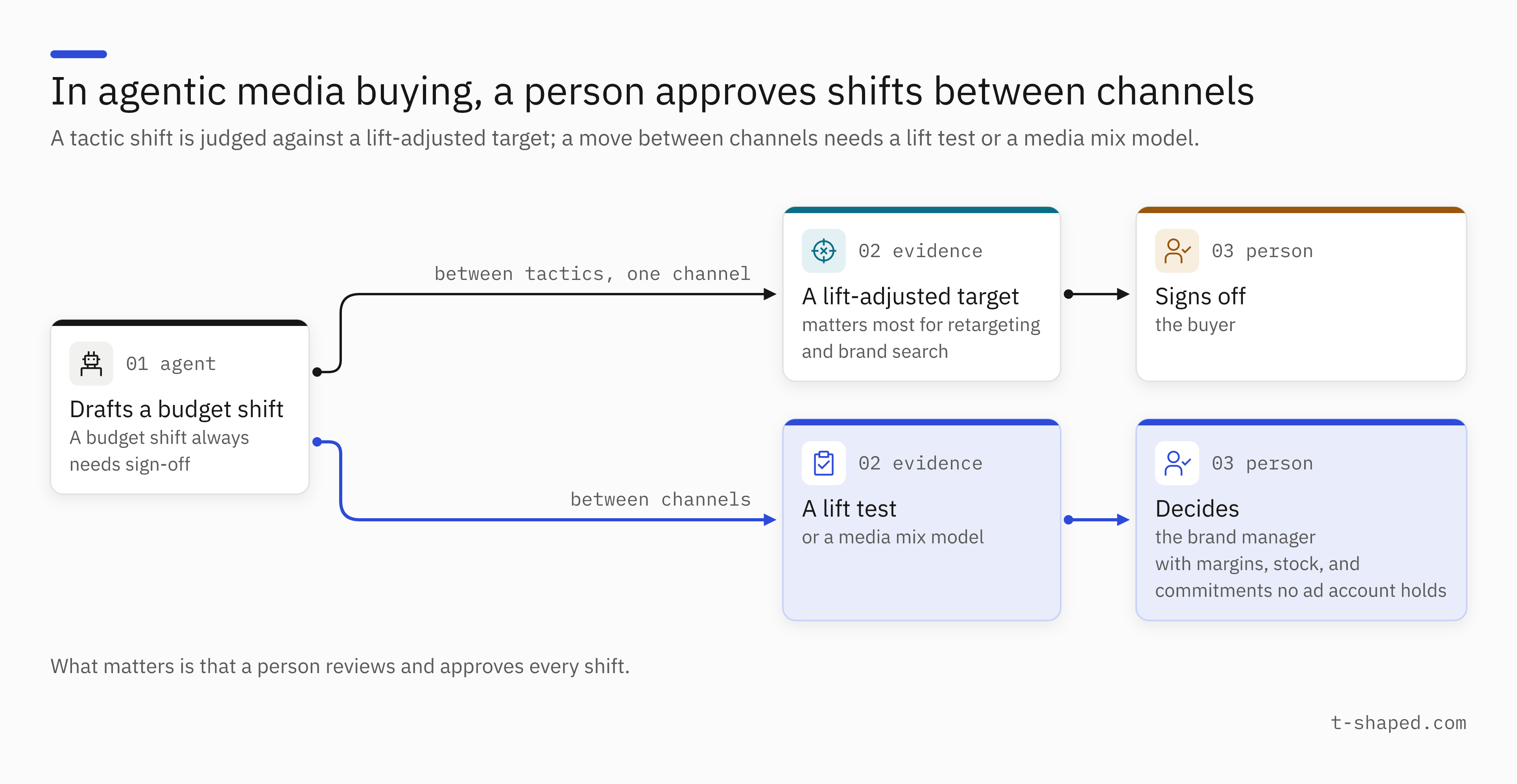
A person decides budget allocation across channels
Budget allocation across channels rests on margins and commitments no ad account holds, and its evidence arrives weeks later, so a person reviews and approves each shift.
A randomized lift test measures what ads caused
A platform counts each conversion it can tie to an ad view or click inside its attribution window. The window is the days after a view or click in which a conversion still counts5. That includes sales from people who would have bought anyway. A lift test, a randomized test that holds some people back from the ads, measures incrementality: the sales an ad caused that would not have happened without it.
Researchers compared 663 randomized experiments at Facebook with two methods that estimate effects without a test, using richer data than most advertisers can access42. For lower-funnel outcomes, those closest to a sale, the experiments' median lift was 5%, while the other two methods put it at 24% and 64%42. A platform's own count has no held-back group either, so it is no more reliable than those methods.
A move between channels compares counts each platform makes its own way, so it needs a lift test or a media mix model, a statistical model of how each channel's spend drives sales, calibrated with lift tests. Without either, the brand manager judges the shift on the brand's own sales.
Lift results adjust the target the agent checks against
If the brand has lift test results, a shift between tactics inside one channel is judged against a lift-adjusted target, the platform target corrected by those results. That matters most in tactics that reach people already likely to buy, such as retargeting and brand search, where the platform's own return on ad spend overstates what ads caused by the widest margin.
Incrementality factor can be defined as the incremental conversions a test found divided by the conversions the platform reported43. With a factor below one, the CPA target on the platform's count sits below the real goal. A factor above one, as when a lift test reads store sales no platform sees, puts it above. In this example, a factor of 0.6 turns a $150 CPA goal into a $90 platform target43. With a factor per tested channel and campaign type in its standing instructions, the agent checks similar campaigns against the adjusted target.
No connector sees the whole budget across channels
The best case for handing an agent the split across channels is that a media mix model already recommends one. The agent would only apply it faster. But the model and the lift tests behind it lag the spend. Its split predates the brand's current margins, stock, and commitments, such as a CPG brand's retailer agreements. None of those sit in an ad account, and the brand manager weighs them as they change.
When the agent drafts a shift from social to retail media for the snack brand, the brand manager decides. At some brands the buyer and the brand manager are one person. What matters is that a person reviews and approves every shift.
Download: SVG, PNG, MP4. Wider than the screen: swipe sideways, or download the PNG.
Make agencies and vendors prove agentic media buying on your account
Put six questions to any agency or vendor selling agentic media buying, then check the answers by running its agent read-only on your own account.
Ask each question, and look for this answer:
-
Which connector. The platform's official one where it exists, with its tool list shown to you.
-
Which level. One per task, such as Level 1 for reporting and Level 4 for budget changes, agreed between your team and theirs.
-
Whose login, with which role. A dedicated login your brand owns, read-only to start, so the change history shows the agent, not a buyer. Meta says its connector accepts a system user, though not one with the admin role12.
-
Which limits stop a bad change. Limits the platform enforces, plus the written rules.
-
Where every change is logged. The change history, the team's change log, and who reads them.
-
Who covers a bad change. The contract names it.
Limits matter most for a scheduled task, which the AI assistant runs on its own at set times. Anthropic says a scheduled task in its coding tool, Claude Code, can use every tool of each connector the task includes, "including writes, without asking for permission during a run"44. The same page says a scheduled task's connector actions appear as the signed-in user44.
Run scheduled tasks under that dedicated login, with only the connectors each task needs. Keep that login read-only. Give it write access only when its role and the platform's own limits can block every kind of edit the account owner has not cleared.
Compare the agent's proposals with your buyer's own calls
No public case from a vendor, agency, or platform, as read in October 2026, shows an agent running retail or CPG campaigns with a result from anyone but the seller. Before you sign, have the person who checks the agent's explanations while it is read-only compare its proposals on your account with the platform's figures and with what the buyer would have done.
When one agency runs both the agent and the account, someone at the brand reads the comparison, because the seller should not grade its own work.
An agent costs a subscription, model usage, and people's time
- The subscription. The AI assistant's fee.
- Model usage. Every run reads account data into the model. Ask how the subscription bills or limits a scheduled run.
- People's time. Someone sets the agent up, reviews what it proposes, and reads the change history.
No source puts a monthly figure on an agent running an ad account. Ask your agency which tasks an agent now does, and what people's time its fee now pays for.
Marketing operations connects one read-only agent first
Marketing operations or an analyst sets it up with the buyer, and the account owner grants the read-only role, in this order:
-
Pick the AI assistant and a business subscription whose data terms your team accepts. As of October 20, 2026, Anthropic says only the Owners and Primary Owners of a Claude Team workspace can add a connector by its web address22.
-
Add the platform's connector. OpenAI's guide says that in ChatGPT this means entering the connector's address, setting up sign-in, and accepting a risk warning45.
-
Sign in read-only.
- On Meta, grant ads_read rather than ads_management12.
- Where a platform offers no read-only permission, switch its write tools off in the AI assistant. That setting binds only that assistant, which makes it the weaker control.
-
Give it the media plan, and ask for the daily pacing sheet.
Questions this piece answers
What is agentic media buying?
Agentic media buying is an AI agent reading and changing your ad accounts through a connector, under a login your team sets up. The connector presents the platform's API to a language model as a named list of tools, such as pulling yesterday's spend or changing a campaign's budget, and the agent can do only what its tools exist for and what the login it runs under allows.
Which ad platforms let AI agents change campaigns?
As of October 20, 2026, Meta's connector (in open beta) and TikTok's let an agent build and change campaigns, and of the retail media networks checked, only Amazon's official connector, an open beta for companies already on its ad API, does. The Google Ads MCP server only reads, searching metrics, budgets, and status, so the agent proposes new budgets and the buyer enters them in Google Ads.
Can you limit what an AI agent changes in Meta ads?
Meta lets a business set limits on what an agent creates and changes, in limited availability, and each one blocks one agent action on one ad account or product catalog, such as "any budget increase above 20%". Meta's connector enforces them, and a partner given access to an ad account, such as an agency, can set its own limits there, which cover only the partner's own people.
What should an AI agent do first in our ad accounts?
Give it the analyst's daily pacing sheet and three QA checks under a read-only login, and have it explain why spend moved. Pacing and QA checks change nothing, so they show whether the agent reads your numbers correctly before it may propose a change.
Should an AI agent move budget between channels?
The agent can draft a shift between channels, and a person reviews and approves every shift. A move between channels compares counts each platform makes its own way, so it needs a lift test or a media mix model calibrated with lift tests.
How do you check an agency selling autonomous media buying?
Ask which connector, which level, whose login with which role, which limits stop a bad change, where every change is logged, and who covers a bad change, then check the answers by running its agent read-only on your own account. Before you sign, have the person who checks the agent's explanations while it is read-only compare its proposals on your account with the platform's figures and with what the buyer would have done.
Sources
- 1 The State of PPC: Global Report 2026 https://cdn.prod.website-files.com/64ec68244172089051b43f1f/69aeb9b9b2d7797ac1fdfc52_The%20State%20of%20PPC%202026%20-%20Global%20Report.pdf
- 2 Display Advertising with Real-Time Bidding (RTB) and Behavioural Targeting https://ar5iv.arxiv.org/html/1610.03013
- 3 About Performance Max campaigns https://support.google.com/google-ads/answer/10724817?hl=en
- 4 Advantage+ Campaign Experience for Sales, App, and Leads https://developers.facebook.com/docs/marketing-api/advantage-campaigns
- 5 Ad Campaign Learning Stage Info https://developers.facebook.com/docs/marketing-api/reference/ad-campaign-learning-stage-info/
- 6 Tools (Model Context Protocol specification, revision 2026-07-28) https://modelcontextprotocol.io/specification/2026-07-28/server/tools
- 7 Google Ads MCP server: Developer integration guide https://developers.google.com/google-ads/api/docs/developer-toolkit/mcp-server
- 8 Google Ads access model https://developers.google.com/google-ads/api/docs/oauth/access-model
- 9 Glossary https://platform.claude.com/docs/en/about-claude/glossary
- 10 Microsoft Advertising MCP Entity Tools https://learn.microsoft.com/en-us/advertising/guides/mcp-tools?view=bingads-13
- 11 AI Max for Search and other product news for August 2026 https://about.ads.microsoft.com/en/blog/post/august-2026/ai-max-for-search-and-other-product-news-for-august-2026
- 12 Get started (ads MCP server) https://developers.facebook.com/documentation/ads-commerce/ads-ai-connectors/ads-mcp-server/ads-mcp-server-get-started
- 13 Introducing Meta Ads AI Connectors: Manage Your Meta Ads From the AI Tools You Already Use https://www.facebook.com/business/news/meta-ads-ai-connectors
- 14 TikTok for Business connector https://claude.com/marketplace/connectors/tiktok-for-business
- 15 About TikTok for Business MCP Server https://ads.tiktok.com/resources/help/article/about-tiktok-for-business-mcp-server
- 16 TikTok World 26: Turning discovery into business growth with AI-powered innovations, vertical experiences, and high-impact brand solutions https://newsroom.tiktok.com/tiktok-world-26-turning-discovery-into-business-growth-with-ai-powered-innovations-vertical-experiences-and-high-impact-brand-solutions?lang=en
- 17 Pinterest MCP Server https://developers.pinterest.com/about-pinterest-mcp/
- 18 Pinterest’s new AI tools for the discovery era: from ads to personalized shopping https://newsroom.pinterest.com/news/cannes-2026/
- 19 The Snap Ads MCP Server Is Now Live https://forbusiness.snapchat.com/blog/snapchat-ads-mcp
- 20 Google's AI advisors: agentic tools to drive impact and insights https://blog.google/products/ads-commerce/ads-advisor-and-analytics-advisor/
- 21 Ad creation and management https://developers.facebook.com/documentation/ads-commerce/ads-ai-connectors/ads-mcp-server/ads-mcp-server-tools-ad-creation-and-management
- 22 Get started with custom connectors using remote MCP https://support.claude.com/en/articles/11175166-get-started-with-custom-connectors-using-remote-mcp
- 23 Manage ads from an AI agent with Meta ads AI connectors https://www.facebook.com/business/help/1456422242197840
- 24 Ads MCP server rules best practices https://developers.facebook.com/documentation/ads-commerce/ads-ai-connectors/ads-mcp-server/ads-mcp-server-rules-best-practices
- 25 About Product GMV Max https://ads.tiktok.com/resources/help/article/about-product-gmv-max?lang=en
- 26 Scaling Innovation, Full-Funnel Growth, and Performance: Key Themes from CES 2026 https://www.walmartconnect.com/resources/articles/2026/ces-2026-key-themes
- 27 Introducing the Amazon Ads MCP Server https://advertising.amazon.com/library/news/amazon-ads-mcp-server-open-beta
- 28 Tool Reference (Criteo Retail Media MCP) https://developers.criteo.com/mcp/docs/retail-media/tool-reference
- 29 Get Started with MCP https://developers.criteo.com/mcp/docs/criteos-model-context-protocol-mcp
- 30 Connecting to the Amazon Ads MCP Server https://d3a0d0y2hgofx6.cloudfront.net/en-us/mcp/get-started.md
- 31 Skai Launches Agent Connect, Opening Its Omnichannel Marketing Infrastructure to External AI Agents https://skai.io/press-releases/skai-launches-agent-connect-opening-its-omnichannel-marketing-infrastructure-to-external-ai-agents/
- 32 Skai Agent Connect: Give Your Agents Media Superpowers https://skai.io/agent-connect/
- 33 AI Access vs. AI Intelligence: A CTO Guide https://www.circana.com/post/ai-access-vs-ai-intelligence-a-cto-guide
- 34 SPINS Launches Agentic Discovery to Help CPG Brands Win in the Era of AI-Powered Commerce https://www.spins.com/press/spins-launches-agentic-discovery-to-help-cpg-brands-win-in-the-era-of-ai-powered-commerce/
- 35 Levels of Autonomy for AI Agents https://knightcolumbia.org/content/levels-of-autonomy-for-ai-agents-1
- 36 Limits and Best Practices (Marketing API Insights) https://developers.facebook.com/documentation/ads-commerce/marketing-api/insights/best-practices
- 37 Ad Account (Marketing API reference) https://developers.facebook.com/documentation/ads-commerce/marketing-api/reference/ad-account
- 38 Activity logs https://developers.facebook.com/documentation/ads-commerce/ads-ai-connectors/ads-mcp-server/ads-mcp-server-tools-activity-logs
- 39 Change Event https://developers.google.com/google-ads/api/docs/change-event
- 40 About the "Experiments" page (formerly drafts and experiments) https://support.google.com/google-ads/answer/10682377?hl=en
- 41 Self-Serve Ad Terms (updated version, effective October 30, 2026) https://www.facebook.com/legal/self_service_ads_terms_preview
- 42 Close Enough? A Large-Scale Exploration of Non-Experimental Approaches to Advertising Measurement https://arxiv.org/abs/2201.07055
- 43 Incrementality: The Fundamentals https://www.haus.io/blog/incrementality-fundamentals
- 44 Cloud scheduled tasks (Claude Code docs) https://code.claude.com/docs/en/web-scheduled-tasks
- 45 Connect and test your plugin https://developers.openai.com/plugins/deploy/connect-chatgpt
Notes on confidence
Every claim above was checked against its cited source on . In all, 119 more sources in the research file were read for context and not cited:
- Bringing programmatic buying to reservation deals everywhere, Google (Ad Manager blog)
- OpenRTB, IAB Tech Lab
- About Smart Bidding, Google Ads Help
- Drive conversions across Google’s ad channels with Performance Max campaigns, Google Ads Help
- About Smart Bidding learning, Google Ads Help
- How to make target adjustments with Search Smart Bidding, Google Ads Help
- Advantage Campaign Budget, Meta for Developers
- Meta Platforms, Inc. (META) Second Quarter 2026 Results Conference Call, Meta Platforms (Investor Relations)
- DoubleVerify’s 2025 Global Insights Report Reveals How AI Is Improving Workflow Efficiencies and Driving Business Outcomes, DoubleVerify
- Basis User Study Report: How Basis Simplifies Digital Advertising, Basis Technologies (study by Directions Research)
- 2026 Digital Video Ad Spend & Strategy Full Report, IAB (Interactive Advertising Bureau)
- Retail Media Buyer’s Guide, IAB (Interactive Advertising Bureau) Retail Media Committee
- Labor-Based Fees Remain Dominant Form Of Agency Compensation: ANA Report, ANA (Association of National Advertisers)
- 2026 Digital Advertising Trends Report, Smartly
- Specification (Model Context Protocol, revision 2026-07-28), Model Context Protocol (Agentic AI Foundation, Linux Foundation)
- Authorization (Model Context Protocol specification, revision 2026-07-28), Model Context Protocol (Agentic AI Foundation, Linux Foundation)
- CampaignBudget (Google Ads API v26 reference), Google (Google Ads API documentation)
- Date ranges (Google Ads Query Language), Google (Google Ads API documentation)
- Measuring AI agent autonomy in practice, Anthropic
- Linux Foundation Announces the Formation of the Agentic AI Foundation (AAIF), Anchored by New Project Contributions Including Model Context Protocol (MCP), goose and AGENTS.md, The Linux Foundation
- Writing effective tools for agents - with agents, Anthropic (Engineering at Anthropic)
- Introduction to AdCP, AgenticAdvertising.org (AdCP documentation)
- MCP forces ad tech to rebuild agent servers as sessions disappear, PPC Land
- Google Ads MCP Server, Google (googleads GitHub organization)
- Access levels and permissible use, Google for Developers (Google Ads API)
- Google Analytics MCP Server (Experimental), Google (googleanalytics GitHub organization)
- Try the Google Analytics MCP server, Google for Developers (Google Analytics)
- 3 new ways Ads Advisor is making Google Ads safer and faster, Google (The Keyword blog)
- Meet Ask Advisor, your new AI-powered collaborator, Google (The Keyword blog)
- Microsoft Advertising MCP Server Setup Guide, Microsoft Learn (Microsoft Advertising)
- Building a new AI economy that creates value for everyone, Microsoft Advertising blog
- AdLoop, AdLoop (open-source project, GitHub kLOsk)
- Budgets overview, Google for Developers
- Account budgets, Google for Developers
- Google LLC Advertising Program Terms, Google LLC
- Ad Activity (Marketing API reference), Meta for Developers
- Self-Serve Ad Terms, Meta
- Securing AI agents: When AI tools move from reading to acting, Microsoft Security Blog
- OpenAI Help: Lockdown Mode, Simon Willison's Weblog
- How long do you store my organization’s data?, Anthropic Privacy Center
- Introducing Claude Sonnet 5.5, Anthropic
- PubMatic and Butler/Till Launch AdCP-Enabled Agentic AI Campaign Across CTV, PubMatic
- How Multi-Agent AI Is Changing the Way CPG and Retail Brands Manage Advertising at Scale, AWS for Industries (Amazon Web Services)
- Consumer Heterogeneity and Paid Search Effectiveness: A Large Scale Field Experiment, National Bureau of Economic Research
- How measurable is online advertising?, INFORMS
- Retail Media ROAS Demystified: A Guide To Understanding Your Brand’s ROAS, Ovative Group and Albertsons Media Collective, w/ Northwestern University Kellogg School of Management professors
- IAB/MRC Retail Media Measurement Guidelines, IAB and Media Rating Council
- The Future of Retail: Expo West 2025, NielsenIQ
- Ads MCP Server, Meta for Developers
- Comprehensive reporting, Meta for Developers
- Catalog creation and management, Meta for Developers
- Signals and datasets, Meta for Developers
- Help and troubleshooting, Meta for Developers
- A/B tests and conversion lift studies, Meta for Developers
- Rate limiting (Marketing API), Meta for Developers
- Evolving TikTok for Business MCP: New AI platforms to streamline your ad workflows, TikTok for Business Blog
- TikTok unveils AI-powered updates for advertisers driving discovery, action, and measurable business outcomes, TikTok Newsroom
- Reddit Ads API v3, Reddit
- Introducing System Users for Ads API Integrations, Reddit Ads API Blog
- Performance unlocked: Reddit Max campaigns are now available to all advertisers, Reddit, Inc.
- Meta Ads MCP (pipeboard-co/meta-ads-mcp README), Pipeboard (GitHub)
- TikTok Brings Its Ads MCP to Claude, Perplexity and Six More, The Keyword
- Overview (Amazon Ads MCP Server developer guide), Amazon Ads
- Connecting to the Amazon Ads MCP Server (Lite), Amazon Ads (Amazon Ads API documentation)
- campaign_management: MCP tools related to campaign_management (Amazon Ads MCP tool reference), Amazon Ads
- Expert tools bring AMC SQL generation to your agent, Amazon Ads
- unBoxed 2026 news: Explore the latest advertising announcements, Amazon Ads
- Amazon Ads introduces Full-Funnel Campaigns, DVA+, and enhanced chat experience in AI-powered ad platform, Amazon Ads Agent, Amazon Ads
- unBoxed 2025: Introducing Ads Agent, Amazon Ads
- Partner Types and API Access, Walmart Connect (Walmart Developer Portal)
- Introduction to Walmart Connect - Sponsored Search APIs, Walmart Connect (Walmart Developer Portal)
- Criteo and dentsu Launch First Fully Orchestrated MCP Campaign, Criteo
- Connect your AI agent to Instacart with MCP, Instacart
- Introduction to advertising on Instacart, Instacart
- API Partner Program: Take your advertising campaigns to the next level, Instacart
- Pacvue Launches MCP Server, Making Commerce Media Data Accessible Across Enterprise AI Tools, MarTech Series
- Skai Launches MCP, Powering AI Agents Across Its Open Omnichannel Platform, Skai
- Digital Ad Revenue Climbs to Nearly $300B as IAB Celebrates 30 Year Anniversary, IAB
- Internet Advertising Revenue Report: Full-year 2025 results, IAB and PwC
- Retail media takes more than half of CPG ad budgets, WARC
- Butler/Till Unlocks Greater Efficiency and Performance with PubMatic AgenticOS, PubMatic
- Cuisinart achieves an 18-point higher detail page view rate with Creative Agent, Amazon Ads
- Amazon Ads introduces DVA+ and enhanced chat experience in AI-powered ad platform, Amazon Ads Agent, Amazon (company news published on iTWire)
- Updates to Smart Bidding Strategy Naming and Organization in Google Ads, Google Ads Developer Blog
- Ad Set, Meta for Developers
- From Walled Gardens To Working Media: The Rise Of Commerce Media, Forrester
- Key Changes (Model Context Protocol specification, revision 2026-07-28), Model Context Protocol (Agentic AI Foundation, Linux Foundation)
- Ads MCP, Snap for Developers
- Schedule recurring tasks in Claude Cowork, Anthropic (Claude Help Center)
- Scheduled tasks (ChatGPT documentation), OpenAI (ChatGPT product documentation)
- Notifications (ChatGPT documentation), OpenAI (ChatGPT product documentation)
- Model Context Protocol (ChatGPT documentation), OpenAI (ChatGPT product documentation)
- Schedules in Gemini Apps, Google (Gemini Apps Help)
- Manage your tasks & workflows in Gemini Apps, Google (Gemini Apps Help)
- Connect & manage custom apps for Gemini Apps, Google (Gemini Apps Help)
- Additional policies, Amazon Ads
- Amazon Advertising API License Agreement, Amazon Ads
- Set up a custom experiment, Google Ads Help
- Experiments overview, Google Ads API (Google for Developers)
- Split Testing, Meta for Developers
- Lift Study, Meta for Developers
- About Conversion Lift, Google Ads Help
- About change history, Google Ads Help
- Ad Activity, Meta for Developers
- Meridian GeoX, Google for Developers (Meridian)
- Tool use with Claude (overview), Anthropic (Claude Platform documentation)
- Programmatic tool calling, Anthropic (Claude Platform documentation)
- Tool search tool, Anthropic (Claude Platform documentation)
- What is the Google Ads API Developer Assistant?, Google (Google Ads API documentation)
- Google Ads scripts: get started, Google (Google Ads scripts documentation)
- Create a Message (Messages API reference), Anthropic (Claude Platform documentation)
- Circana Advances Liquid AI Technology With Powerful Capabilities to Revolutionize Decision Making, Circana
- Foundry: Powering Agentic Commerce, SPINS
- Calibrate treatment priors, Google for Developers (Meridian)
- Set custom ROI priors using past experiments, Google for Developers (Meridian)
- Key Features, Meta (Robyn documentation)
- Guidelines for Incremental Measurement in Commerce Media, IAB and IAB Europe
- Introducing Causal Attribution: An Evidence-Backed Method for Making Daily Spend Decisions, Haus
- Measured Has A New Tool That Lets Marketers Chat With Their Incrementality Data, AdExchanger
Changes since publication
Researched and drafted with AI assistance. Reviewed, edited, and approved by Scott Zakrajsek. Every claim is checked against its source. How the articles are made.